Case Studies
From a gridlocked WTO to the push for a greener and fairer trade agenda to the race to fix global tax governance, these three case studies examine where the system is under strain and how the EU can help steer reform.
Reforming the WTO
As the World Trade Organization (WTO) marks its thirtieth anniversary, mounting geopolitical tensions are putting strain on its effectiveness. How do these pressures impact the organisation’s core functions? And where do realistic reform opportunities remain?
Key Findings
- Reform efforts to make the WTO more effective and robust such as reviving dispute settlement have so far largely stalled.
- There is little room for improvement within the WTO’s formal, rules-based functions.
- Some progress, however, is still possible in less formal areas and formats, such as dialogue, coordination, and information-sharing among members.
- Fundamentally, important WTO members hold differing views on what the organisation should deliver, making consensus difficult to obtain.
Key Reform Potential
- WTO reform is likely to continue to face persistent obstacles. Multilaterally minded members should therefore focus on preserving the WTO’s core functionality in the short term.
- Limited effectiveness-oriented reform may be possible in low-key, often informal plurilateral processes that are oriented at information exchange and transparency, but that do not imply legally binding commitments. Members should pursue such reforms but not expect them to address the underlying divisions.
- An open discussion about the very purpose of the organization is needed to narrow the deep split among WTO’s principal members.
Key Actor Positions
The EU aims to make the WTO more effective and relevant, while supporting flexible and plurilateral solutions. However, the EU has recently focused more on geoeconomic interests, industrial policy, and its relationships with the US and China.
China presents itself as a defender of free multilateral trade, supporting WTO reformand seeking to preserve export-driven growth. Yet it also resists reforms thatchallenge its own economic model. Beijing views the US’s position as the mainobstacle to WTO reform.
The US has grown increasingly sceptical of the WTO. Washington argues the organisation is failing to address concerns over China’s trade practices and is constraining US economic and security interests. As a result, it favours a more flexible system and is willing to challenge core WTO principles.
-> Read more about actor positions in the report
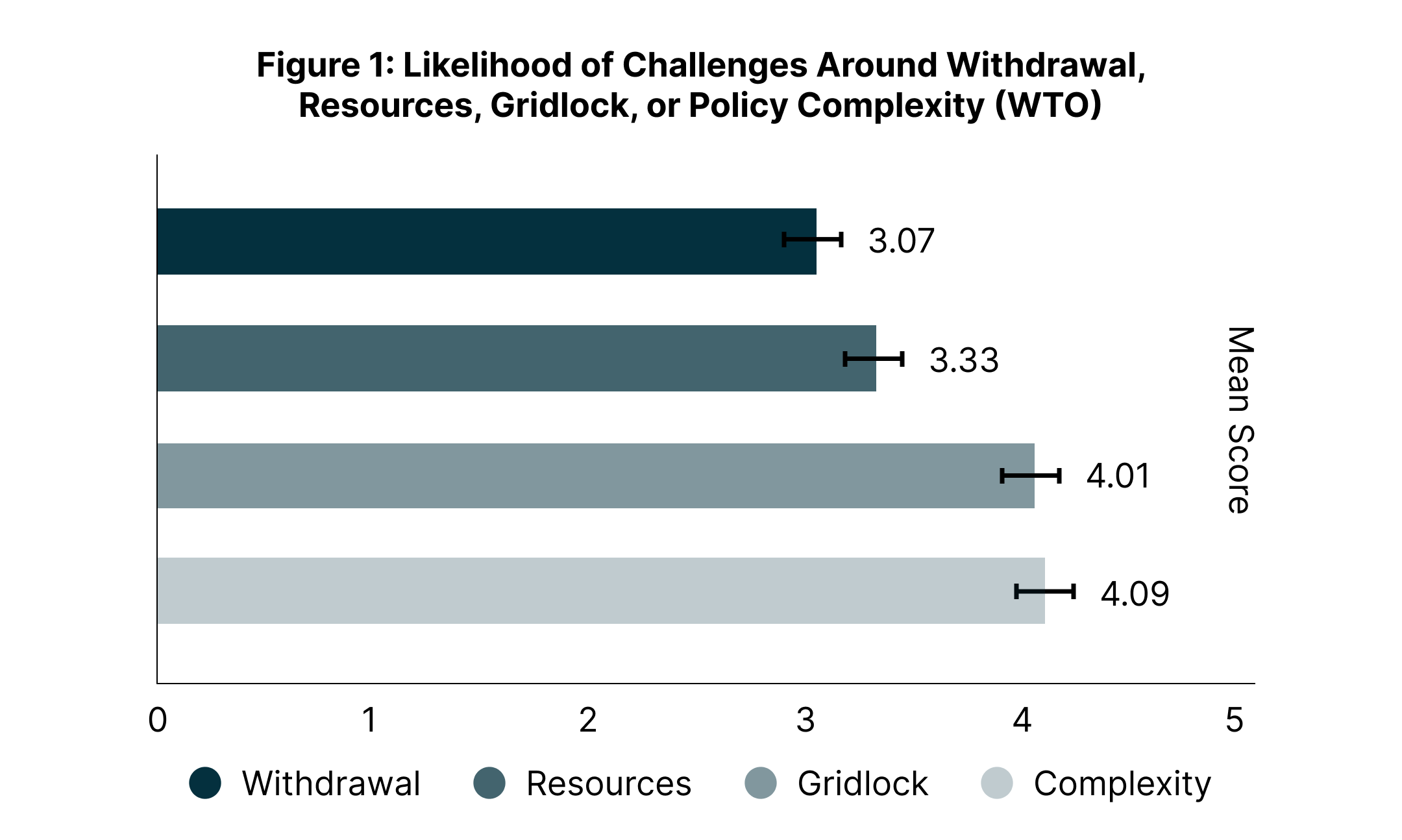
Note: For the WTO, experts see policy complexity and gridlock as the most likely challenges by 2030. Responseoptions: 0 (almost) impossible; 1 very unlikely; 2 rather unlikely; 3 rather likely; 4 very likely; 5 (almost) certain. Source: Expert Survey
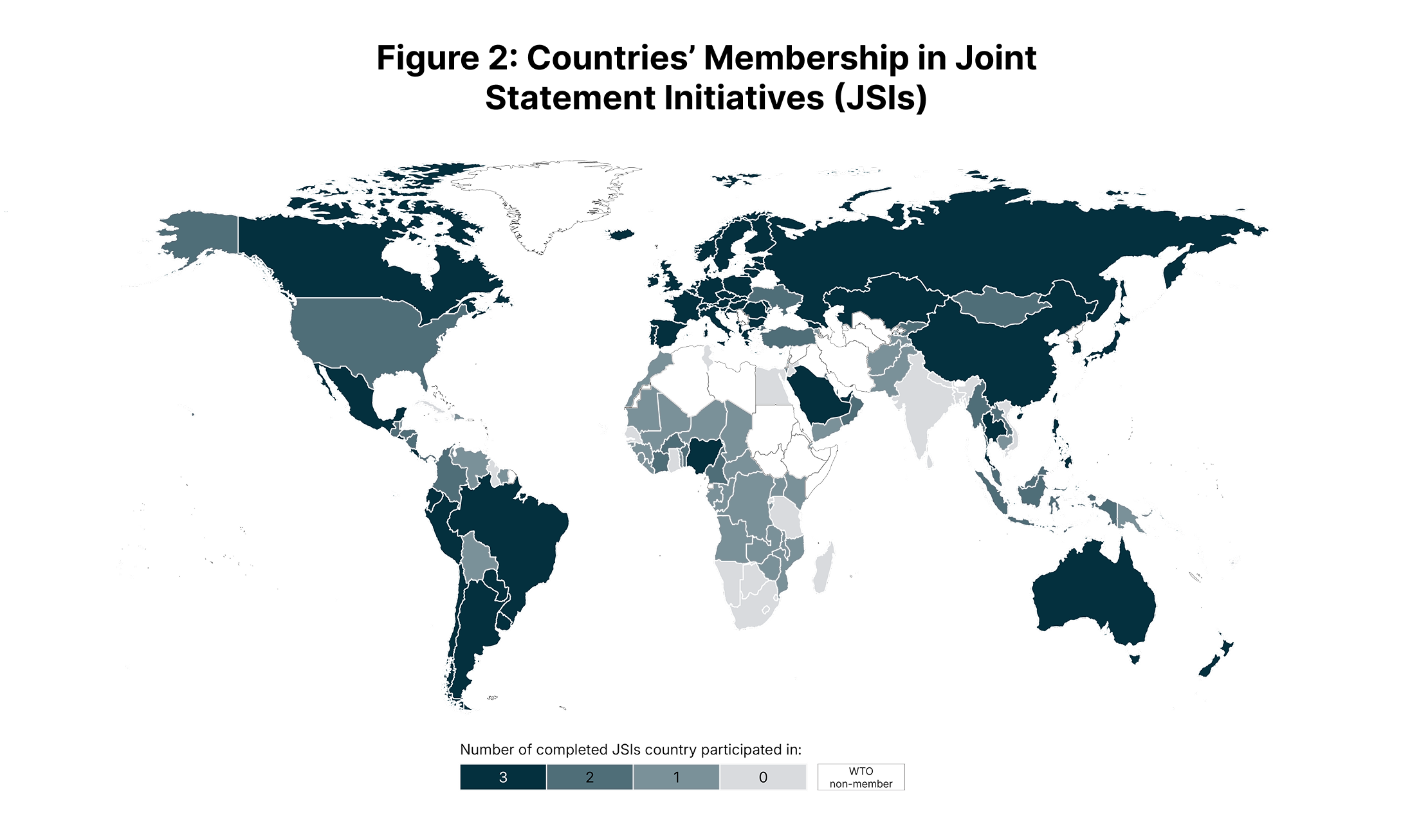
Note: WTO members have increasingly engaged with Joint Statement Initiatives. Source: WTO Reform Report
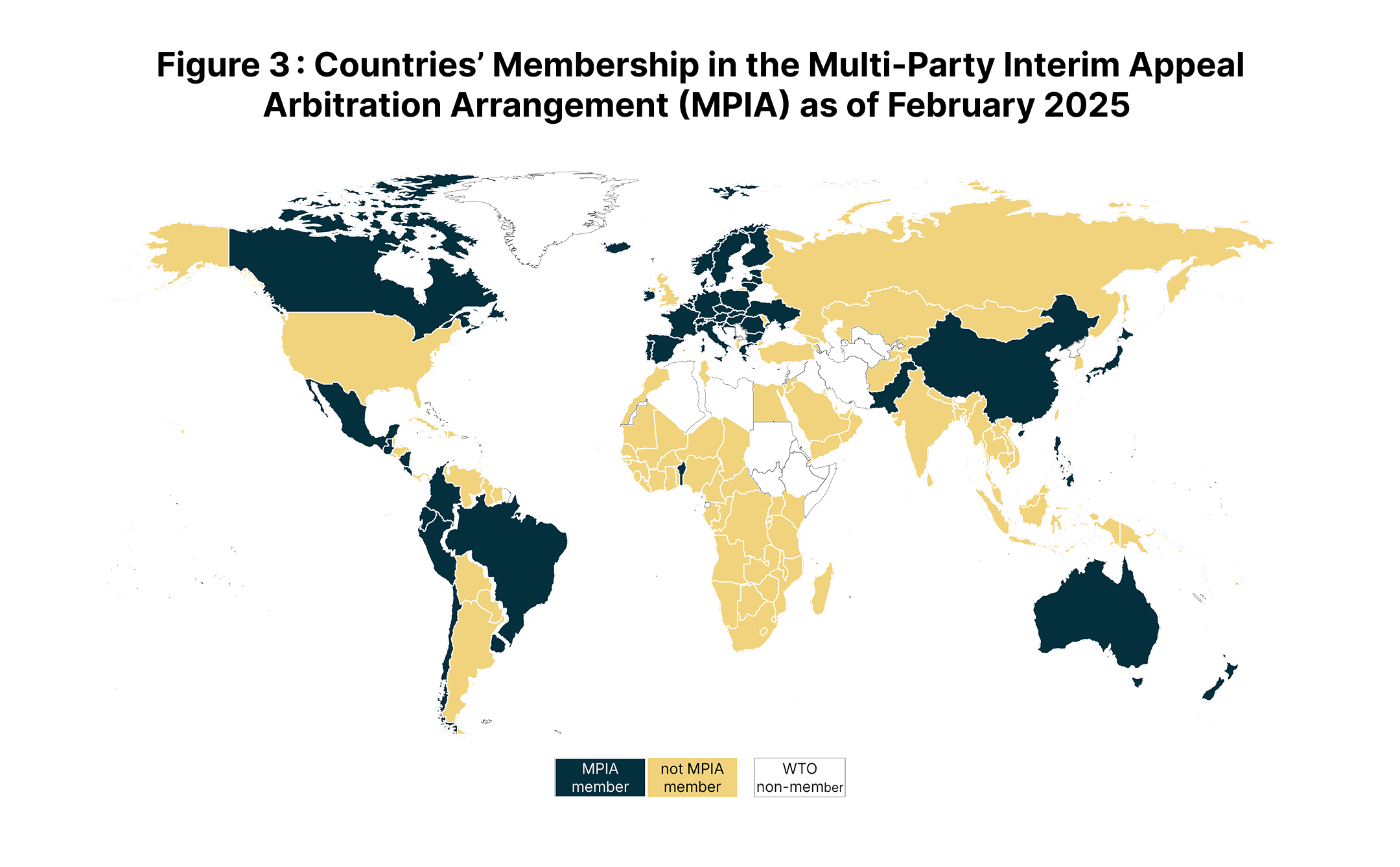
Note: WTO members have increasingly joined the Multi-Party Interim Appeal Arbitration Arrangement. Source: WTO Reform Report
Expanding the WTO's Scope
Geopolitical tensions and institutional deadlock are putting increasing pressure on the WTO. How are members responding to proposals to expand the WTO’s scope beyond ‘classical’ matters of trade to include global development, environmental sustainability, and inclusiveness issues?
Key Findings
- WTO members are deeply divided over expanding trade-related agendas, with conflicts especially acute around member states’ development status and environmental regulation.
- The development agenda remains gridlocked, as debates over special and differential treatment are becoming increasingly geopoliticised.
- The environment agenda has gained momentum but is advancing mostly through informal, non-binding initiatives, with only limited binding rule-making.
- The inclusiveness agenda is politically stalled, with little consensus on definition or scope and only minimal substantive outcomes.
Key Reform Potential
- Expanding the WTO’s work on development, environment, and inclusiveness can help keep the organisation relevant and effective.
- In the current political climate, progress is more feasible through non-binding approaches, such as information sharing, best practices, and voluntary guidelines, than by crafting new binding rules.
- Tensions will certainly arise: How to strengthen effectiveness without weakening the WTO’s core rules? How to promote innovation while maintaining broad participation and transparency? Managing these trade-offs will be critical for the WTO’s future.
Key Actor Positions
The EU advocates for including environment and inclusiveness in WTO’s scope to boost the organisation’s relevance. These issues align with the EU’s liberal normative orientation and its own transition toward a green economy. It also aims to protect European producers from suffering competitive disadvantages.
China is pragmatic when it comes to regime expansion. It supports selected environmental initiatives, is rather sceptical about inclusiveness, and is opposed to reforming ‘developing’ versus ‘developed’ member status.
The US strongly prioritises core WTO issues while it opposes the development agenda and is mostly unsupportive of the environment and inclusiveness agenda.
-> Read more about actor positions in the report
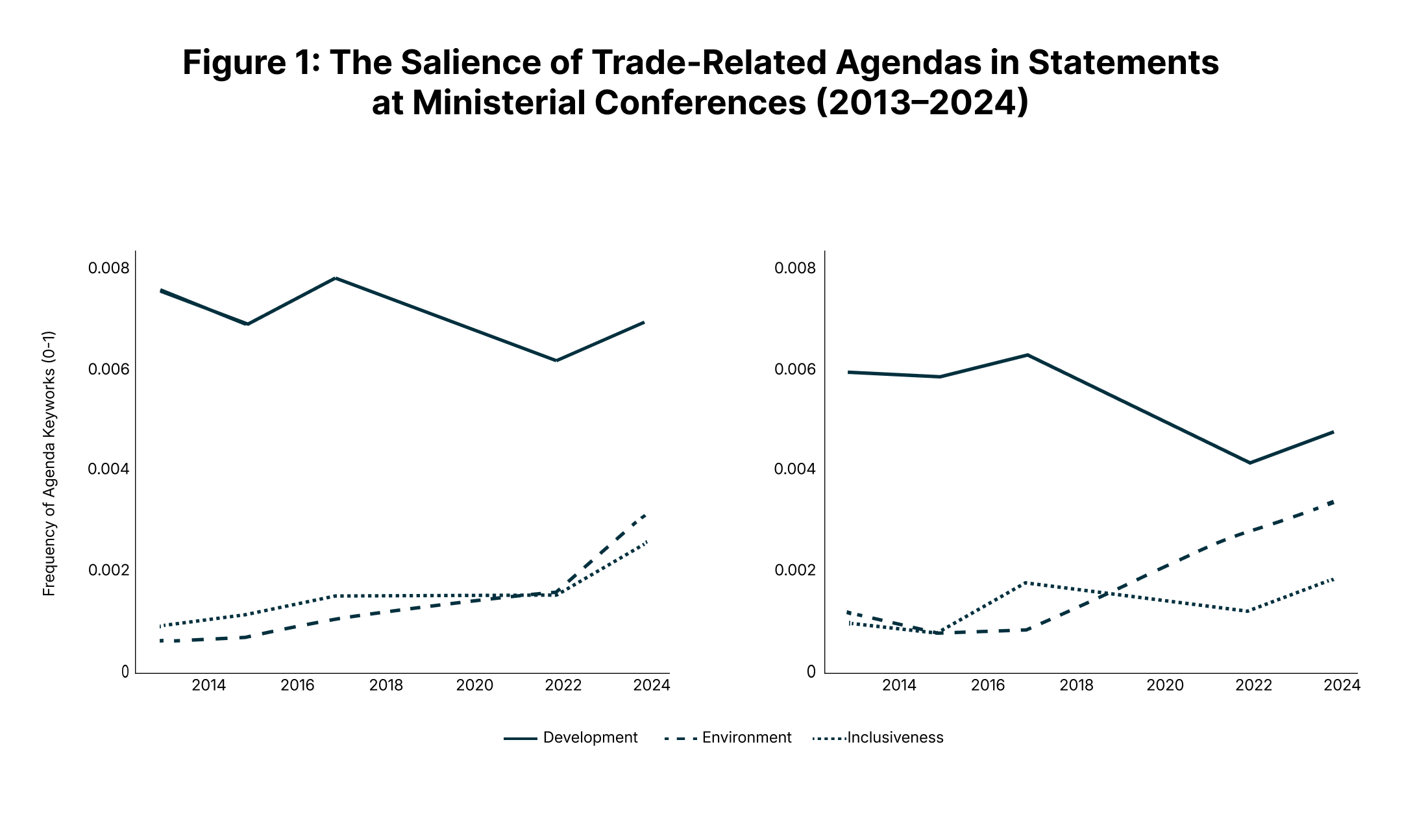
Note: In WTO ministerial statements, references to environment and inclusiveness have grown steadily. Source: Expanding the WTO’s Scope Report
Photo: Flickr / Enrique Mendizabal (CC BY-ND 2.0)
Reforming Global Tax Governance
Every year, governments lose hundreds of billions due to tax avoidance and profit shifting. How can two reform initiatives, led by the Organisation for Economic Co-operation and Development (OECD) and the United Nations (UN) respectively, address such tax avoidance and profit shifting effectively and democratically?
Key Findings
- The first initiative, the OECD/G20 Inclusive Framework, has largely been an effectiveness-driven process. In order to maintain US engagement, however, it did allow for key carve-outs, limiting the Framework’s effectiveness.
- The second, UN-led initiative, on the other hand, prioritised participation, favouring equality and inclusion. Its long-term effectiveness is unclear at this stage.share ↓ by ~3pp in import-competing sectors
- Neither forum currently ensures a reform process that is both effective and democratic. Future progress will depend on addressing this trade-off.
Key Reform Potential
- The future of international tax cooperation will depend on whether the OECD and UN processes can converge into a process that is both inclusive and capable of delivering tangible results.
- The EU should help forge a viable and balanced solution. It should engage constructively in the UN process; this would allow Brussels to shape a framework that is both inclusive and operational, mitigating fragmentation while reinforcing its credibility as a global governance actor.
Key Actor Positions
The EU supports multilateral tax governance, notably through implementing the global minimum tax. However, its role is constrained by member state competences and preferences. The EU pursues consensus-based approaches and seeks to avoid duplication with other international frameworks.
China approaches international tax as a strategic tool to support its multinationals and broader foreign policy, while remaining cautious about binding global reforms that offer limited direct benefits. It positions itself as a pragmatic, compromise-oriented actor, supporting multilateral initiatives selectively to maintain its image without undermining its economic interests.
The US plays a central role in global corporate taxation but favours unilateral and flexible approaches over binding multilateral rules. Domestic politics and strategic interests — especially under the Trump administration — are driving efforts to protect US firms and limit multilateral commitments, including UN-led initiatives.
-> Read more about actor positions in the report
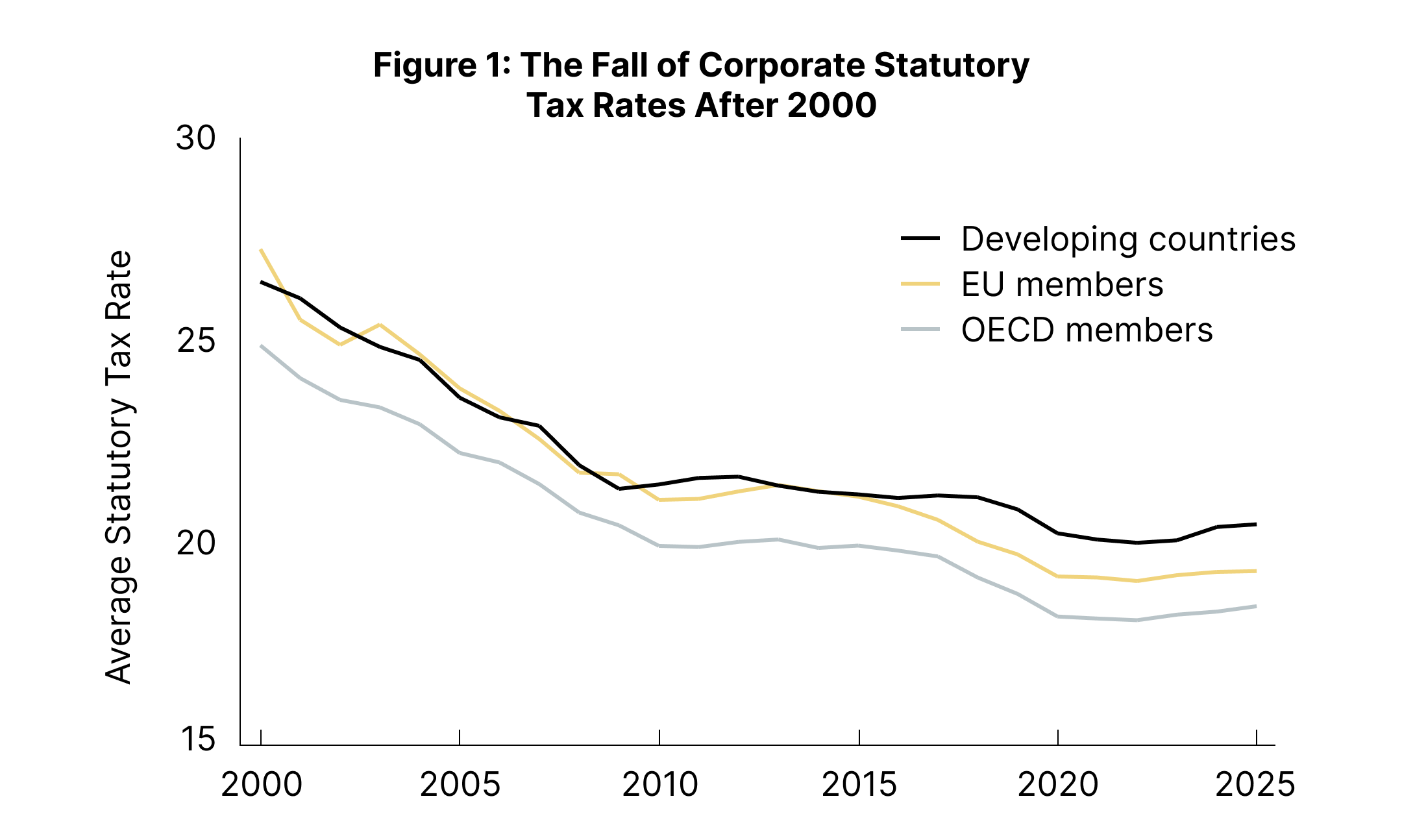
Note: The gradual decline of statutory corporate taxrates has stopped after the Pillar Two announcement, reflecting the indirectpressure of the global minimum tax. Authors based on OECD Corporate Tax Statistics. Source: Overcoming Taxation Policy Brief


.png)


