



In 1946, in the aftermath of World War II, countries came together to adopt the Constitution of the World Health Organization (WHO). The organisation, which was to become a United Nations (UN) agency, was supposed “to act as the directing and co-ordinating authority on international health work.” Fast forward 80 years to today, and there is little left of the WHO’s bold foundational spirit. Its current Director-General, Tedros Adhanom Ghebreyesus, celebrated the Constitution’s 80th anniversary with an op-ed in Nature, titled “Why the Need for the WHO Has Never Been Greater.” The fact that the organisation must now justify its very existence shows how precarious its position has become. Worldwide, development aid is being severely cut, global health is losing its political salience, and the WHO itself faces an increasingly uncertain future. This places a formidable set of challenges before the next WHO Director-General, to be elected in 2027.
While the WHO still enjoys significant legitimacy based on several unique characteristics – including its near-universal membership and notable convening power in the global health domain – donor neglect and mistrust risk turning it into an empty shell. The COVID-19 pandemic triggered a sharp increase in the organisation’s financial resources, but the gains were short-lived and never translated into greater political capital. Less than seven years after the pandemic erupted, the WHO once again finds itself confronting its long-standing struggles to fulfil its directing role and many of its other constitutional functions. The ongoing crisis largely results from the purported withdrawal of the United States (US), but also from the insufficient commitments of other member states and key donors, including the European Union (EU).
For a long time, the EU and its member states combined have contributed most of the WHO’s financial resources. During the pandemic, the EU also emerged as a key ally of the organisation, which found itself under mounting public scrutiny and entangled in the rhetorical confrontation between the US and China. However, the EU’s support for the WHO is falling short of its potential. This policy brief argues that a more effective partnership would require greater willingness from EU institutions – chiefly, the European Commission – to provide flexible funding, mainstream health priorities, and gain visibility within WHO governing bodies. The Commission and EU member states would also need to engage more constructively with the Global South and pursue a more coherent approach to global health governance. Without these conditions, the EU will struggle to bolster the WHO and consolidate its credentials as a global health actor.
Key Challenges for the WHO
Most of the WHO’s current challenges are not new. For decades, the organisation has faced difficulties in securing financial support and asserting itself in an increasingly crowded global health landscape. Internal dysfunction and external discontent have fuelled a narrative of WHO decay dating back to at least the 1990s. Drawing on previous ENSURED research and other sources, this section identifies four primary sources of the WHO’s vulnerability.
1. Inadequate Funding
The WHO’s financial resources do not match the significance and breadth of its mandate. From the late 1980s until the outbreak of COVID-19, membership fees (or ‘assessed contributions’) remained essentially stagnant – in fact, for most of this period, they were not even adjusted for inflation. These shortfalls were offset by an increase in voluntary contributions from states, regional organisations like the EU, and non-state actors. Voluntary funds are unpredictable and generally tied to specific donor priorities, hampering the organisation’s autonomy and capacity for long-term planning while increasing administrative burdens. In 2022, amid a COVID-19-fuelled push to strengthen the WHO’s finances, member states adopted a plan to gradually increase their assessed contributions. Concrete steps in that direction have since followed. However, the Trump administration’s 2025 move to withdraw the US from the WHO and unlawfully withhold its 2024–2025 assessed contributions blew a hole in these efforts. This new funding squeeze has been compounded by delays in payments from other member states and a sharp decline in voluntary funding since 2024.
2. Internal Fragmentation
Practically since its very founding, the WHO has been a heavily decentralised organisation. Its six regional offices – particularly, the pre-existing Pan American Health Organization – enjoy substantial autonomy from the Geneva-based headquarters. This complex structure often compromises the organisation’s coherence. The WHO’s 150+ country offices can serve as critical assets in tackling local needs, but they have also been linked to dysfunction due to inadequate staffing. In addition, the organisation’s persistent reliance on earmarked voluntary funding has led to internal competition for resources and entrenched programmatic fragmentation. Although the WHO Secretariat has repeatedly tried to address these well-documented challenges, there is little appetite among other internal stakeholders, member states, and many non-state donors to overcome the fragmented status quo, primarily due to political interests.
3. Lack of Normative Instruments with ‘Teeth’
One of the WHO’s constitutional functions is “to propose conventions, agreements and regulations, and make recommendations with respect to international health matters.” Yet WHO normative instruments have been slow to materialise. As of today, only one WHO convention is in force: the 2003 Framework Convention on Tobacco Control. In 2025, WHO member states adopted the Pandemic Agreement, a new convention emphasising prevention that would complement the decades-old and predominantly response-oriented International Health Regulations, which faltered during COVID-19 and subsequently underwent some limited revisions. However, the Pandemic Agreement is still missing a highly contentious annex on Pathogen Access and Benefit-Sharing, a central pillar of the treaty’s equity agenda that must be adopted before the entire text can enter into force. If and when this happens, the WHO’s normative authority will be consolidated, though with the significant caveats that much of the treaty’s text is vague and enforcement mechanisms are not foreseen.
4. Uneasy Coexistence with Other Global Health Actors
As the WHO faced open discontent among its members towards the end of the 20th century, partly because of its mismanagement of the AIDS pandemic, many member states – primarily Western ones – chose to advance their global health agendas elsewhere. The US, for example, found the World Bank to be a more amenable and like-minded venue. In 1995, the World Trade Organization (WTO) emerged as the leading international forum governing not only trade but also intellectual property, with enormous repercussions for global health. Soon thereafter, philanthropic entities and public-private partnerships with disease-specific or sectoral mandates brought further competition for funding and became WHO donors themselves, gaining influence over the organisation’s agenda. The WHO’s trademark emphasis on systemic approaches thus ceded ground to shorter-term, narrower, and more measurable interventions. In addition, the WHO has struggled to integrate non-state voices in its governance mechanisms and adopt effective rules regarding conflicts of interest. These factors have prevented the WHO from acting as a real coordinating authority in global health governance.
The EU’s Relationship with the WHO
The WHO is a traditional, state-based international organisation. From an EU perspective, this means that only individual countries are WHO members and EU institutions are relegated to an observer role. Despite this and other legal obstacles, including its limited public health competences, the EU is a prominent global health actor and a key WHO partner in areas such as Universal Health Coverage, the health-development nexus, and the ‘One Health’ agenda linking health to environmental considerations. In addition, the EU has used the WHO as a platform to externalise its own regulatory standards. An illustrative example is the 2003 Framework Convention on Tobacco Control, which the EU greatly influenced and eventually joined as a full party alongside its member states. The EU tried to replicate this experience with its recent promotion of the Pandemic Agreement.
The EU’s support for the WHO is selective, conditional, and ambivalent in practice.
Financially, the EU has also left a notable imprint on the WHO. The contributions of EU member states, in the form of both assessed and voluntary funding, have been complemented with EU institutional support, which is entirely voluntary. Not only does this place ‘Team Europe’ – the combination of EU institutions and member states – comfortably in first place among WHO contributors, but the Commission itself consistently finds itself in the top 10. In 2024–2025, the Commission already ranked fourth among WHO donors, and after the US withdrawal it is projected to climb to second place, overtaking the Gavi Vaccine Alliance and trailing only the Gates Foundation. Like most voluntary contributors, however, the Commission always earmarks its resources to specific projects or thematic areas, preventing the WHO from using them at its discretion. To date, the Commission has never provided ‘core’, fully flexible funding.1
This signals some persistent gaps between EU rhetoric and practice. The Commission’s 2022 Global Health Strategy – which was welcomed by EU member states – speaks of the WHO as the “indispensable cornerstone of the multilateral health system,” but the EU’s support for the organisation is selective, conditional, and ambivalent in practice. EU institutions and member states generously fund public-private partnerships like the Global Fund to Fight AIDS, Tuberculosis and Malaria, a financing entity whose relationship with the WHO is often marked by considerable tensions and competitive dynamics. At the same time, the EU has sought to curtail the WHO’s involvement in the regulation of some health-related policy areas, such as intellectual property, leaning towards other organisations like the WTO instead.
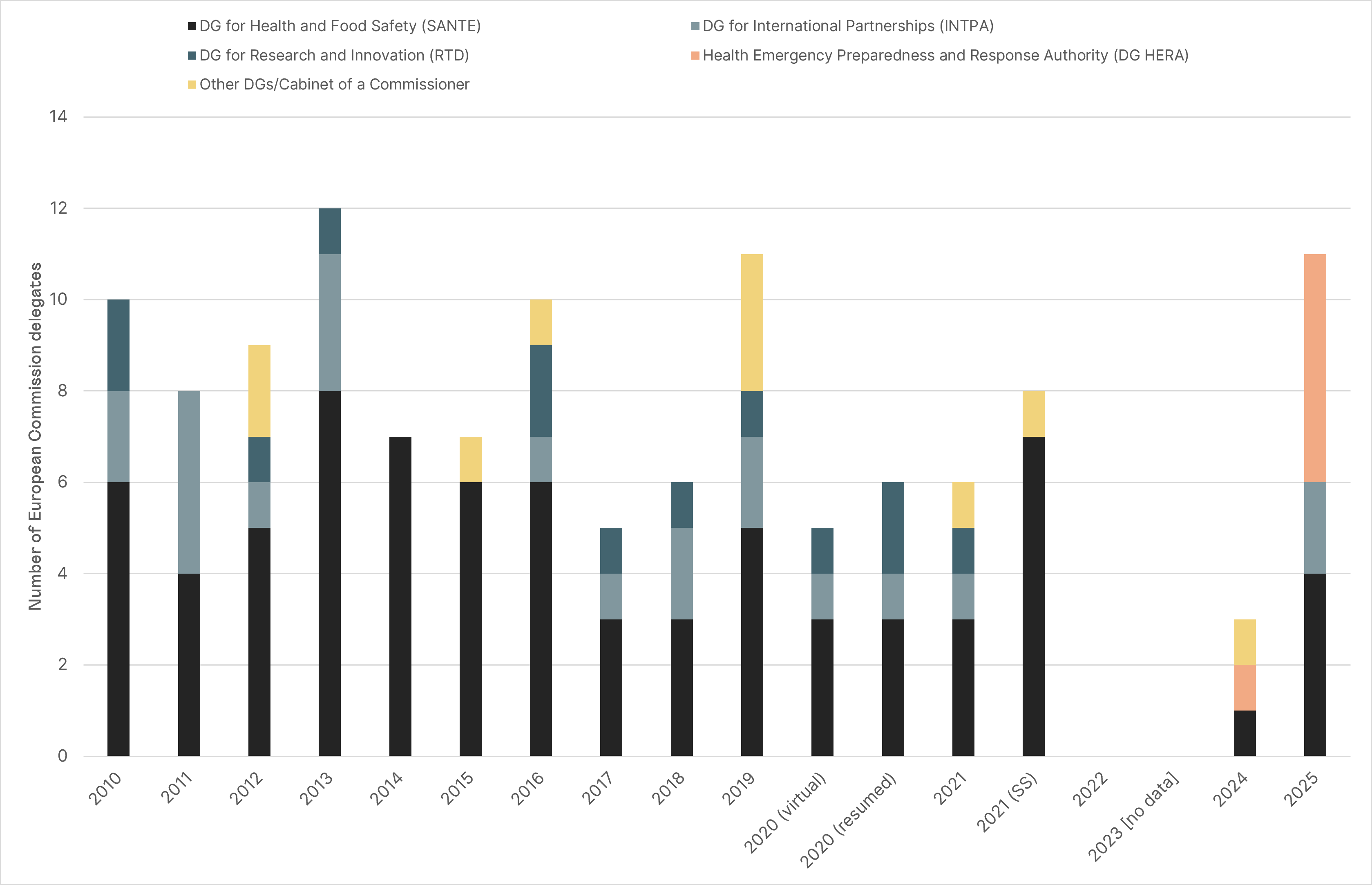
Furthermore, EU institutions are less present than other observers at the WHO’s governing bodies, which creates an image of policy disengagement that is out of step with the scale of EU funding. This is particularly concerning in the case of the European Commission. At the World Health Assembly (WHA), the annual gathering of WHO member-state representatives and the highest-profile diplomatic event in global health, the Commission’s visibility is low and has generally diminished in the years following the outbreak of COVID-19. Some Directorates-General (DGs) of the Commission that used to attend the event in significant numbers have seldom appeared in recent years (see Figure 1). This suggests a degree of institutional siloing that sits uneasily with the EU’s intersectoral ‘Health in All Policies’ motto. Existing studies demonstrate that the Commission tends to subordinate health considerations to other external goals – such as trade liberalisation – and suffers from a disconnect between its internal and external approaches to health policy.
2027 as an Opportunity for Greater WHO Support
Ahead of a crucial election of a new WHO Director-General in mid-2027, all eyes are on WHO donors. This juncture, combined with the dismal state of international cooperation, calls upon the EU to double down on its multilateral instincts and emerge as a more robust and consistent advocate of the WHO. To that end, this policy brief puts forward four recommendations complementing previous takeaways from the ENSURED project (see also our policy toolkit). The recommendations target the EU and its member states and address the key challenges facing the WHO, as outlined above.
Recommendations
- Deliver on multilateral and domestic health funding. An effective WHO is a well-funded WHO. This relates to both the scale and the flexibility of its resources. While the EU does not provide core funding to UN agencies, this is a political choice that could be revised. In contrast to the Commission, some EU member states do resort to this type of flexible funding, but there is still scope for much greater use, following the example of the United Kingdom and a few other countries. In addition, both the Commission and EU member states should consider increasing their share of thematic, partially flexible voluntary funding relative to specified, fully earmarked resources. The WHA agreements reached to raise WHO member states’ assessed contributions are welcome, but they should not come at the expense of voluntary funding. Finally, the EU and its member states should also support the WHO by further aligning their financial and budgetary priorities with the organisation's agenda. This would entail strengthening national health systems and breaking the “cycle of panic and neglect” in pandemic prevention, preparedness, and response. Such commitments should be reflected both in the EU’s 2028–2034 Multiannual Financial Framework and in national budgets.
- Advance institutional cohesion within both the WHO and the EU. The EU is a major partner for the WHO’s Regional Office for Europe (WHO/Europe), based in Copenhagen. Of WHO/Europe’s 53 member states, 27 also belong the EU. Moreover, ties between the European Commission and this WHO region have deep historical roots. Yet the overall framework for cooperation between the Commission and the WHO allows for engagement with the other five regional offices as well. These provisions offer untapped potential for the Commission to strengthen its global role while fostering cohesion and knowledge dissemination across different WHO regions. At the same time, the EU could find ways to improve collegiality in its global health action without necessarily moving “towards full WHO membership” – a Commission proposal that has not gained traction among EU member states. The Commission should focus instead on optimising its own institutional resources in pursuit of more coherent domestic and external policies. Rather than leaving WHO engagement predominantly in the hands of the DG for Health and Food Safety (SANTE), the Commission could draw more systematically on the external expertise of its DG for International Partnerships (INTPA), which already coordinates relations with multiple global health initiatives. Other DGs, particularly the relatively new Health Emergency Preparedness and Response Authority (DG HERA), should be better integrated into EU and global efforts, too.
- Bolster the WHO’s normative and convening role. If the WHO is to thrive, it will largely be thanks to its main comparative advantages: its capacity for norm production and its convening role. Finalising the EU-sponsored Pandemic Agreement would showcase and elevate both. Yet for this milestone to be reached, the Commission – which negotiated the convention on the EU’s behalf – needs to abandon all rhetoric that may appear dismissive of the Global South's equity-related concerns. Rather than seeking to project EU unity at all costs, the Commission should grow more willing to leverage diverse EU member-state positions with an eye to achieving balanced outcomes and fostering external trust – both of which are essential conditions for the treaty’s successful ratification and implementation. The EU’s commitment to the Pandemic Agreement should also be more deeply embedded in other policy instruments. For instance, the new EU Global Health Resilience Initiative mentions the treaty only in passing, despite their shared focus on enhancing global health security. More broadly, the WHO’s governance centrality depends on sustained and visible political support, which in turn requires a more prominent EU presence at the annual WHAs and other global and regional WHO governing bodies.
- Contribute to a more effective, WHO-anchored global health architecture. The election campaign for a new WHO Director-General will overlap with an ongoing WHO-hosted process to reform the global health architecture. Rather than the candidates’ nationality or their expected capacity to mend fences with the Trump administration, a more fundamental factor for the EU to consider in the WHO leadership race is their willingness to engage in these reform debates candidly. Vision and courage will be indispensable to defend a more pivotal and autonomous WHO within a revamped global health architecture, while also improving civil society participation and boosting the organisation’s workforce morale. That said, the EU and its national governments cannot simply defer to WHO leadership on these questions: a frank conversation about their own complicity in deepening fragmentation within and beyond the WHO is long overdue. As a self-declared champion of the WHO, the EU should foster a governance ecosystem that aligns with the organisation’s principles and broad mandate. This would entail enabling the WHO to more meaningfully contribute to the governance of health-related areas beyond its immediate remit – for example, intellectual property. To be sure, such a shift in the EU’s mindset will not suffice for the WHO to fulfil the ambitions enshrined in its Constitution 80 years ago. But it would bring the organisation significantly closer to realising them.
Citation Recommendation: Fernández, Óscar. 2026. “Safeguarding the WHO: A Prescription for an Effective EU Approach to Global Health.” ENSURED Policy Brief 14 (October): 1–9. https://www.ensuredeurope.eu.




.png)


