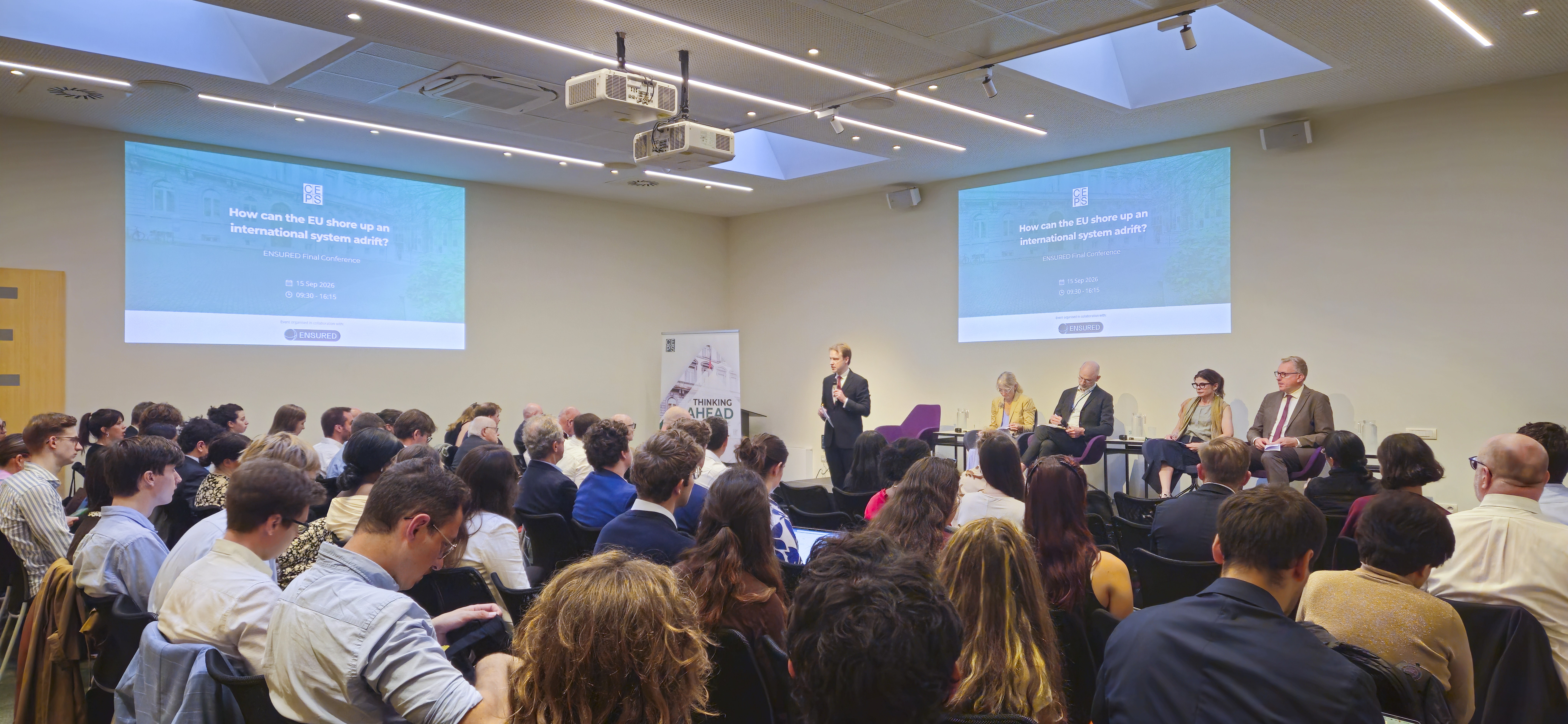

The ENSURED Final Conference, “How Can the EU Shore Up an International System Adrift?”, took place at the Centre for European Policy Studies (CEPS) in Brussels on Tuesday, September 15, 2026.
The conference examined the EU’s role in a multilateral system under unprecedented strain and explored how the EU can actively respond. The conference was structured around an introductory public panel and three thematic panels on (a) building sustainable partnerships with global and regional powers, (b) securing predictable financing for multilateral institutions, and (c) shaping credible EU narratives for multilateral action. The conference was attended by around 80-100 participants. The audience included diplomats, EU officials, academics, researchers, civil society, and NGO representatives working on foreign policy and multilateralism, as well as students interested in the topic.
Opening Session: Public Policy
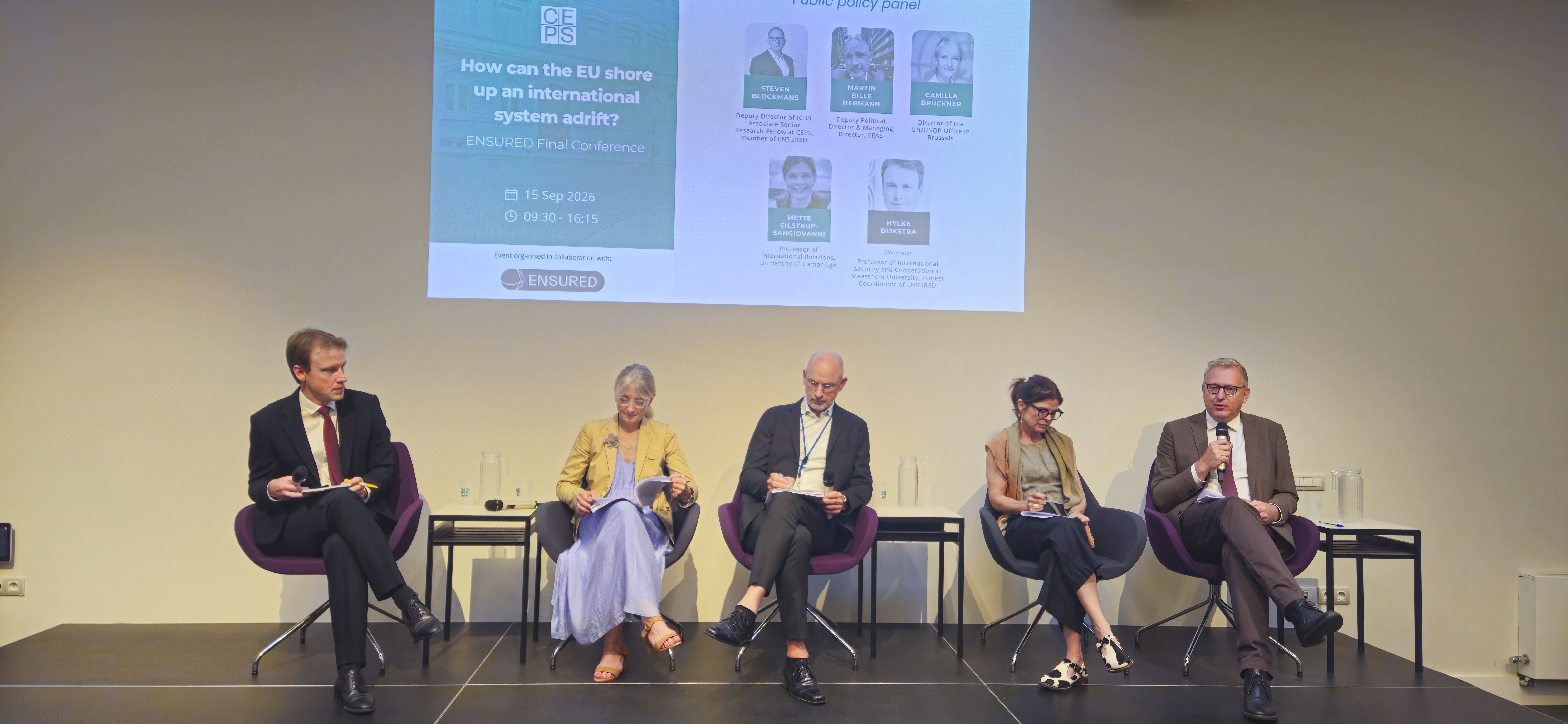
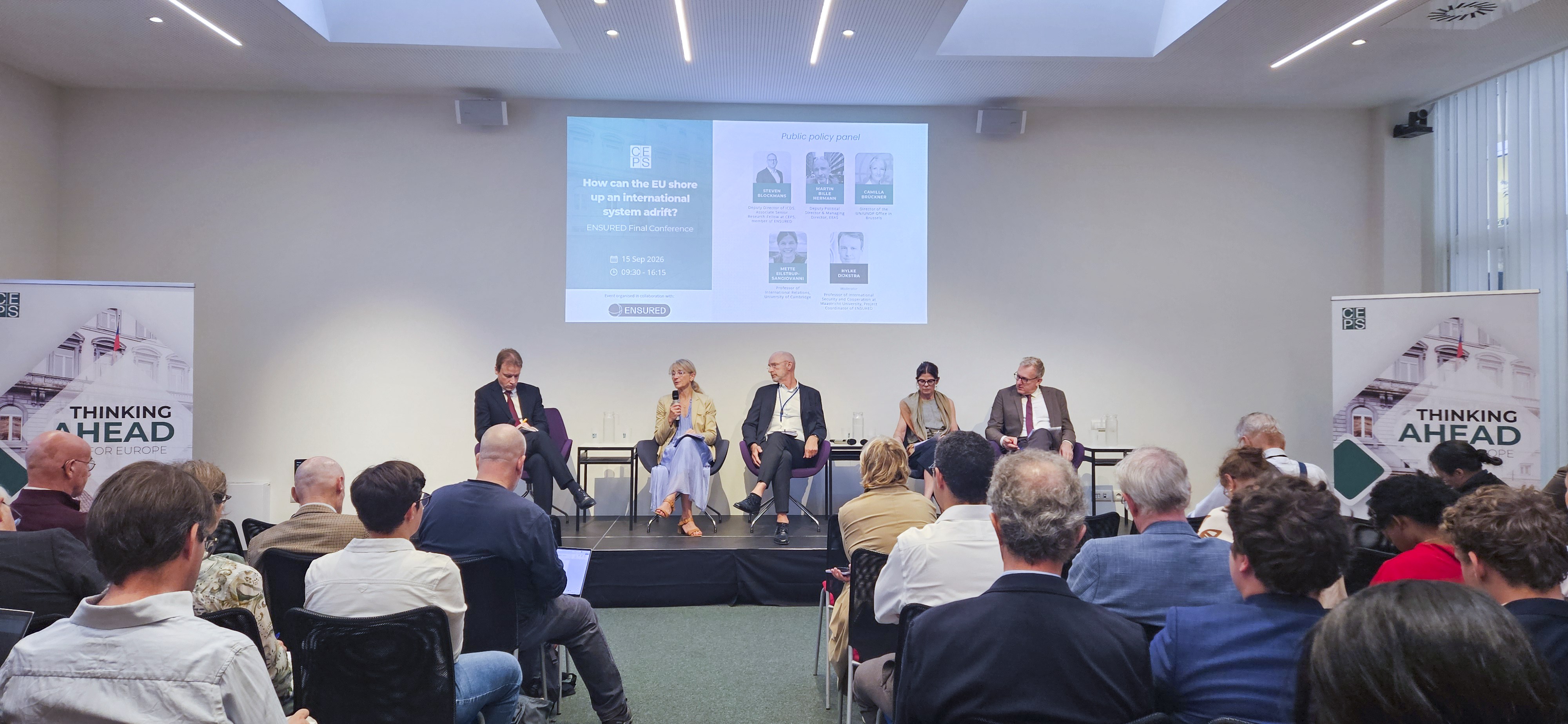
The opening panel, moderated by ENSURED Coordinator Hylke Dijkstra (Maastricht University), explored where gaps in multilateral governance are emerging and the risks they pose, why this matters for the EU, and what approach is needed to both defend and transform the multilateral system. This discussion took place on the eve of the United Nations (UN) High-Level Week in New York, on which the panellists reflected. ENSURED researcher Steven Blockmans (CEPS) introduced the main policy findings from the project, followed by responses from the European External Action Service (EEAS) Managing Director Martin Bille Hermann, Director of the UN Brussels Office Camilla Brückner, and ENSURED Advisory Board member Mette Eilstrup-Sangiovanni (University of Cambridge).
The panellists pointed out that while the need for coordinated international action is high, such coordination is increasingly under pressure. Even though multilateral regimes remain formally in place, their effectiveness depends more and more on plurilateral agreements, coalitions of the willing, and similar ad hoc frameworks. As a result, the system itself has become more hybrid and multilayered, combining unilateral action with flexible, informal arrangements. The issue of trust with regard to multilateralism was also discussed. The panellists noted that the agreements are often made with promises that will only be fulfilled decades later, and unfulfilled commitments may lead to significant loss of trust in the long term. They suggested that bringing practical and successful examples (i.e., good stories) would help to strengthen trust in multilateralism and cooperation as such. In their view, the EU’s leadership role is often taken for granted. Therefore, the EU should focus on the practical benefits of multilateralism with strong emphasis on trust-building and internal coherence. Strengthening monitoring and long-term financing is another vital element in fostering credibility and trust.
Panel 1: Partners

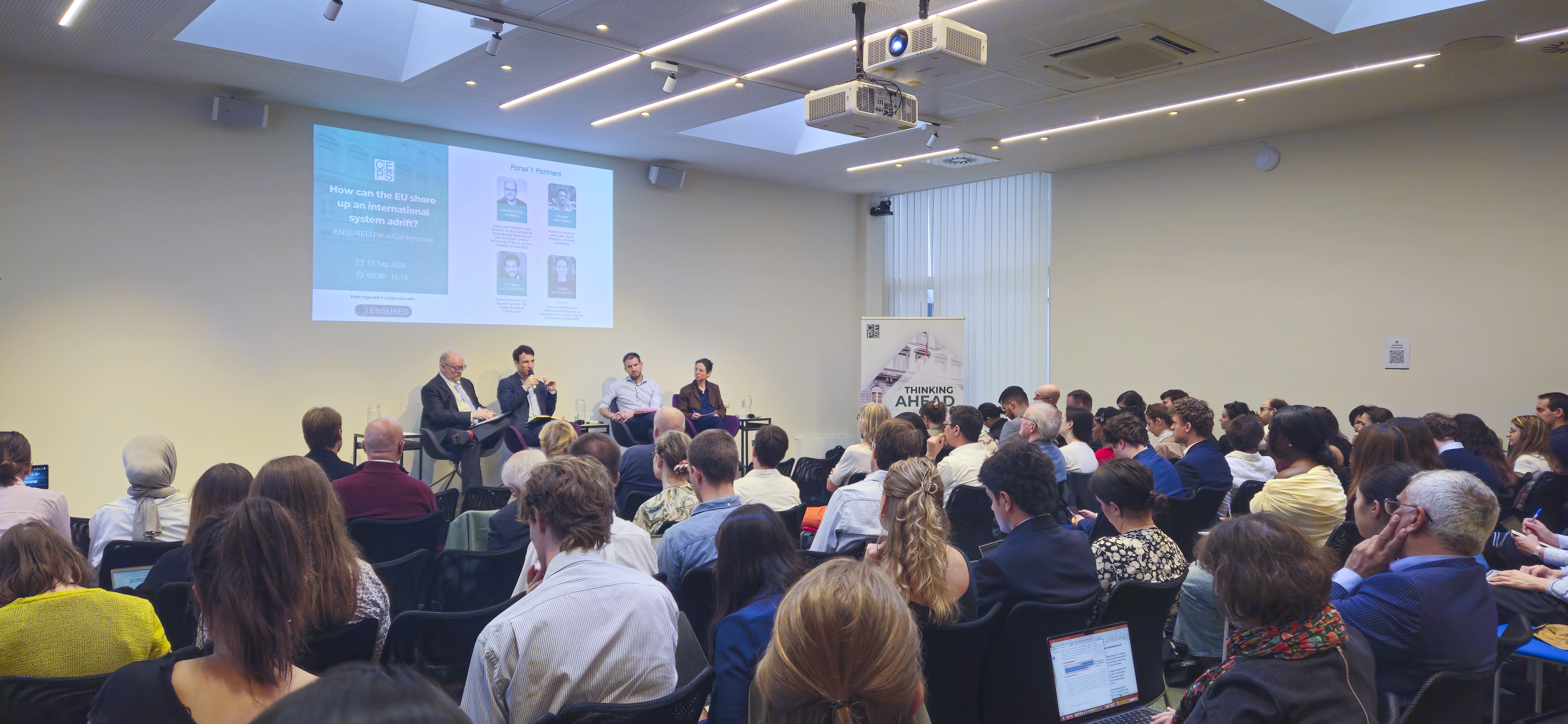
The debate, moderated by ENSURED Deputy Coordinator Clara Weinhardt (Maastricht University), focused on navigating a fragmented global order by balancing relationships with established global powers like the United States (US), middle powers such as Canada and Brazil, and swing states of the ‘Plural South’. ENSURED researcher Kai Michael Kenkel (PUC-Rio) opened with key project findings, followed by a discussion with Frank Mattheis (UNU-CRIS) and European Commission official Thomas Lieflaender.
The panellists pointed out that regional engagement is now more limited, while also being more flexible, which reflects a broader fragmentation. As a result, today’s partnerships tend to be more reactive. Therefore, the debate should focus not on how many partnerships the EU has, but on what form or format these partnerships take. They highlighted the African Union (AU) as one of the EU’s most vital partnerships, yet noted that the relationship is somewhat undermined by the lack of reciprocity. The EU draws inspiration from the AU’s more coherent and unified positioning vis-à-vis other major powers. However, the AU’s involvement in ‘European affairs’ (such as the conflict in Ukraine) remains limited, with the EU’s approach so far being restrictive rather than open. Regarding new partnerships, the EU-Canada relationship illustrates the move towards a more interests-focused approach: both sides share mutual interests, with the free trade agreement serving geoeconomic goals and trade purposes while also fostering closer political ties that benefit the EU. Finally, within existing partnerships, the EU should address the issue of double standards, which remains a major concern for its partners – an issue which is closely tied to differences between how the EU presents itself and what it actually does.
Panel 2: Resources
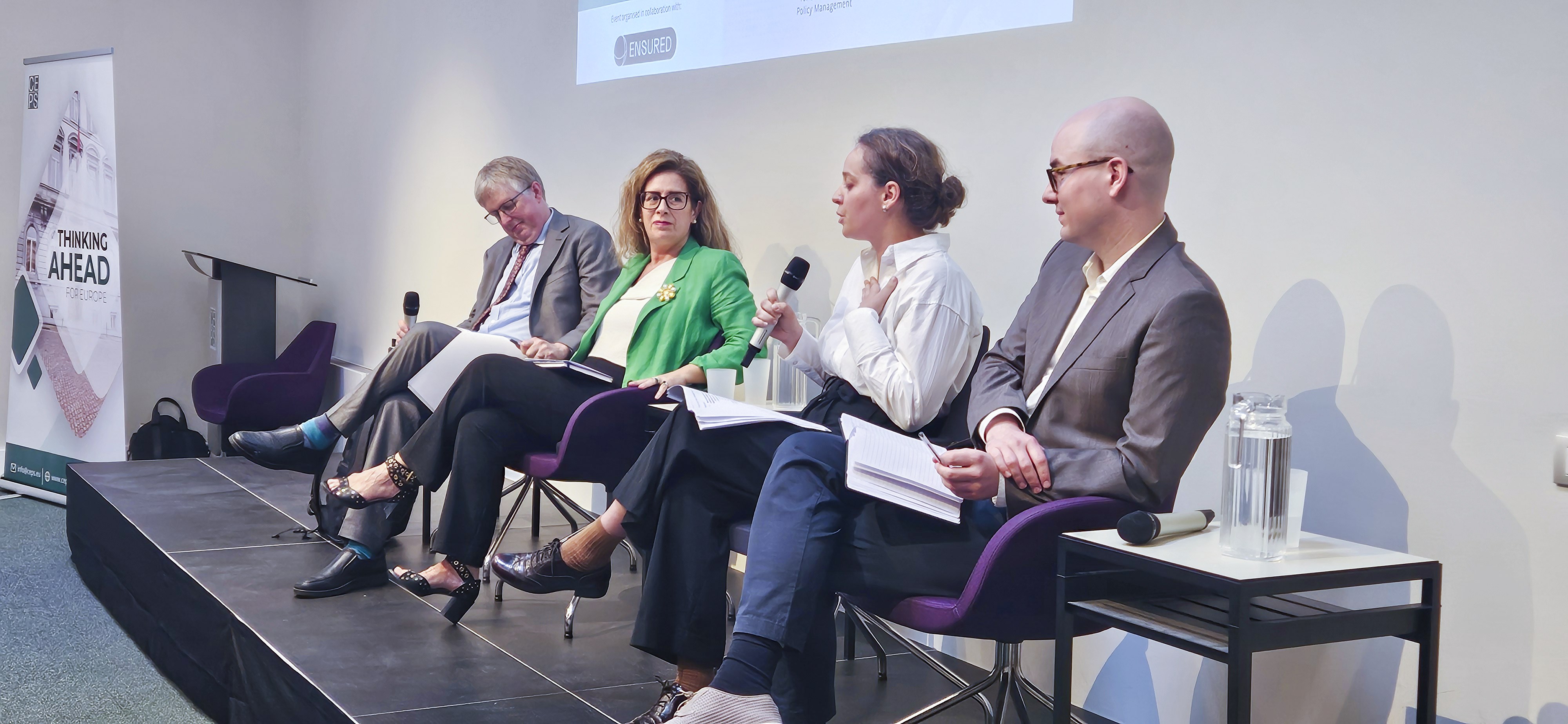
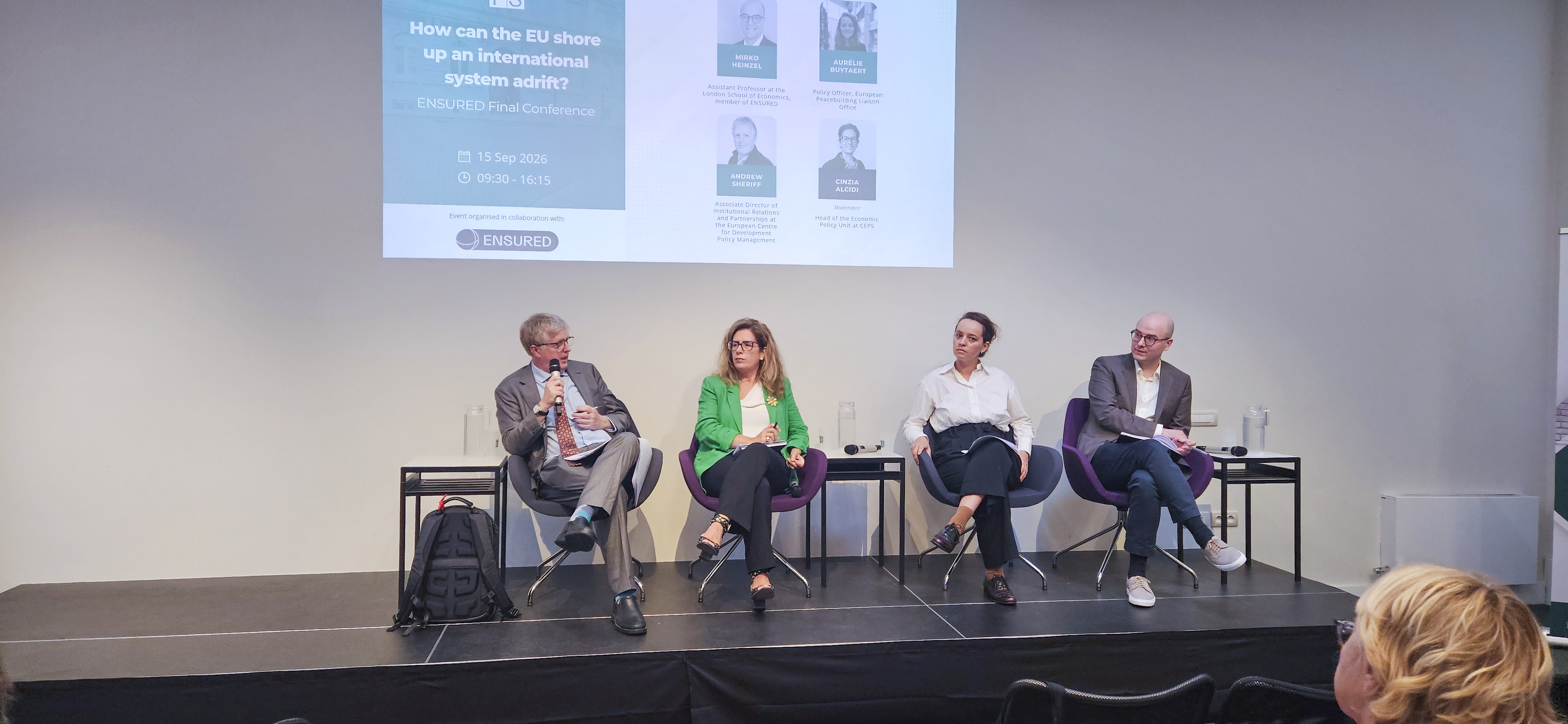
This panel, moderated by Cinzia Alcidi (CEPS), addressed the conflict over funding global goods, highlighting how international financial flows are vital for securing participation but remain highly contested in their amount, source, and governance. The panellists explored how the EU can strategically provide predictable financing to multilateral organisations to protect its core interests and strengthen global cooperation. ENSURED researcher Mirko Heinzel (London School of Economics) introduced some key research findings, followed by responses from Aurélie Buytaert (EPLO) and Andrew Sheriff (ECDPM).
According to the speakers, predictability and stability of resources are key success factors in global governance. In this regard, they suggested that what matters is not only the current volume of resources, but also how much will be available over the next two to three years. This predictability also affects the flexibility available to implementers, who can adjust project goals in response to geopolitical developments. With respect to the EU’s financial contributions, the panellists highlighted its ambition to move from being a ‘payer’ to being a ‘player’. In this context, narrative and trust play an important role. The panellists emphasised the role of civil society, which should be included at the decision-making table, as it is often perceived as more trustworthy than international organisations, particularly in conflict-affected areas. To conclude, the speakers agreed that foreign aid grants the EU access and helps build and strengthen partnerships, even though it represents a relatively small share of the overall EU budget.
Panel 3: Narratives
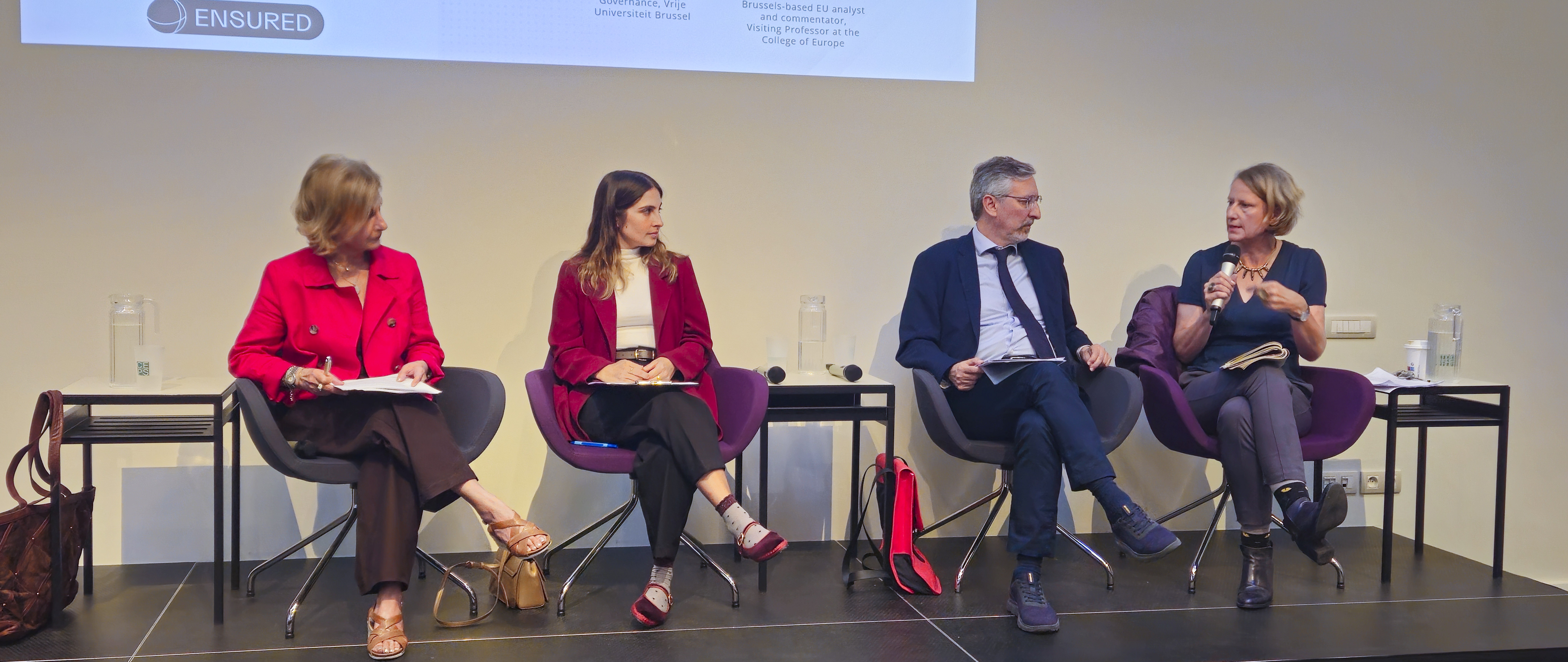
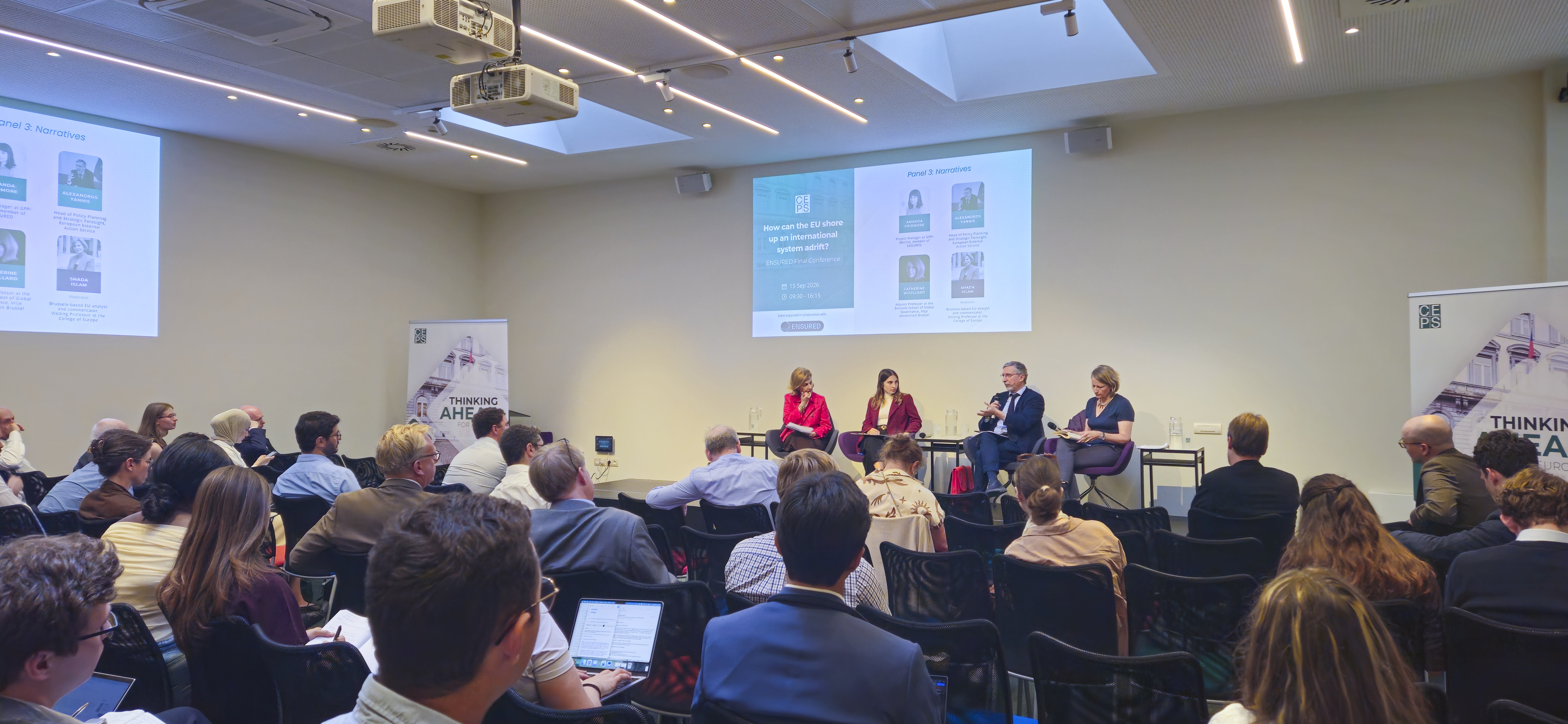
This panel, moderated by Shada Islam (New Horizons Project), explored the tension between the EU’s self-image as a rules-based multilateral leader and its shift towards interest-driven, pragmatic diplomacy in a deteriorating geopolitical climate. The debate focused mainly on the importance of credibility and coherence in narratives. ENSURED researcher Amanda Pridmore (GPPi) presented her research on strategic narratives, followed by a discussion with EEAS Director of the Policy Planning and Strategic Foresight Unit Alexandros Yannis and Catherine Woollard (Vrije Universiteit Brussel).
According to the speakers, in today’s more globalised world, narratives have become increasingly politicised. Yet the EU tells a relatively stable story about itself, typically presenting itself as a multilateral, values-based leader. At the same time, its accounts of the world and its actual policy choices increasingly contradict that self-image. Depending on the domain, system-level narratives oscillate among defending, reforming, and merely instrumentalising multilateralism, while policy narratives increasingly drift towards competitiveness and conditionality. One of the challenges is that narratives should be easy to grasp, which raises the question of how much complexity is appropriate. Attention should also be paid to the exact audiences that the EU seeks to engage with. In conclusion, striking the right balance is always challenging, but doing so is vital to crafting narratives that publics believe and will stand behind.
Photos: CEPS
More snapshots from the conference: