


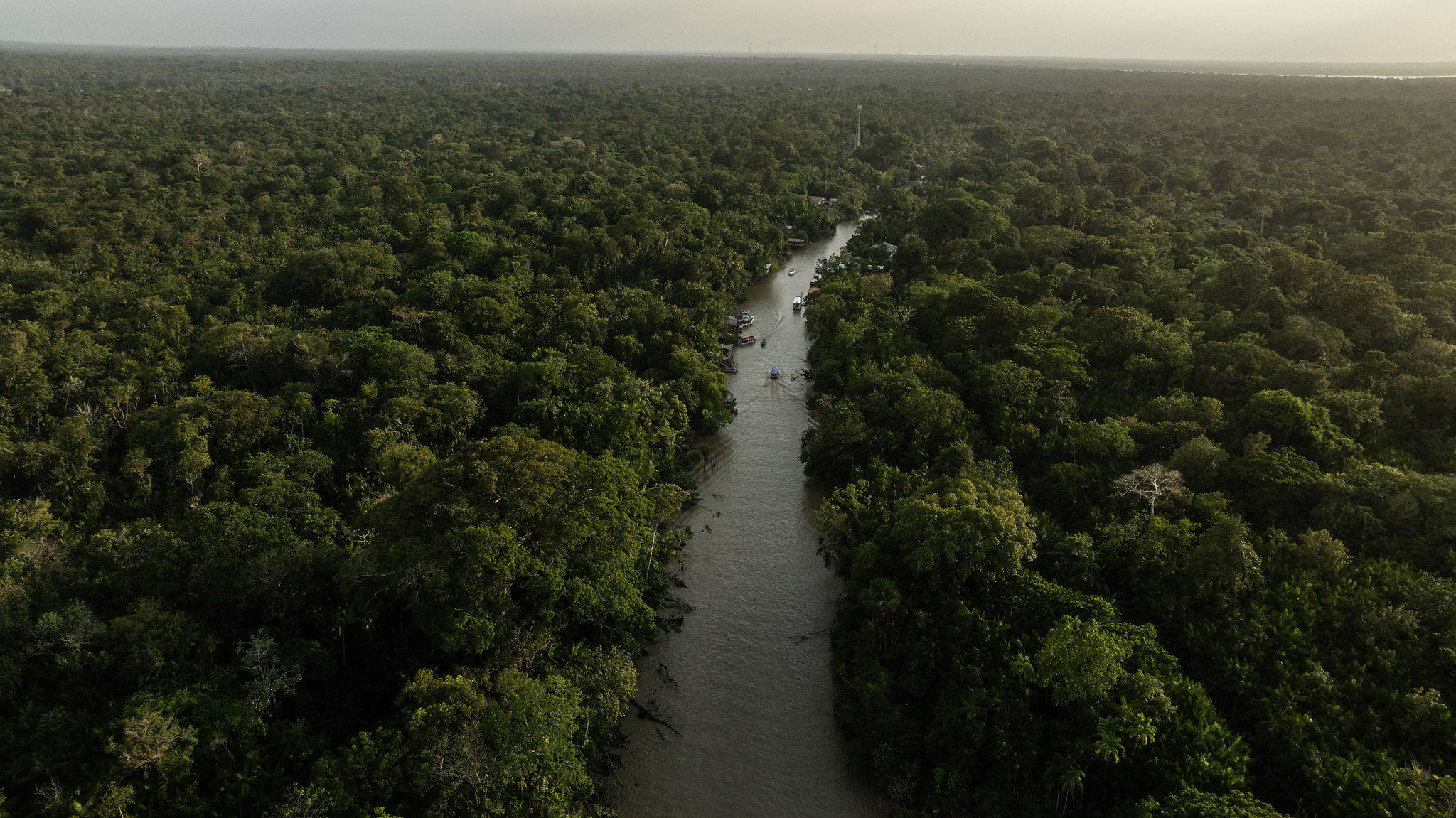

One of the main themes of the 2025 Conference of the Parties (COP30) of the United Nations Framework Convention on Climate Change (UNFCCC) in Belém, Brazil, was the growing recognition among the scientific community, non-state actors (NSAs), and Parties that the climate crisis and biodiversity crisis are deeply connected – and must be addressed as such. In keeping with this logic, COP30 laid the groundwork for ambitious decisions on three biodiversity-related workstreams: (1) synergies between the Rio Conventions, (2) adaptation monitoring indicators, and (3) forest finance and governance. While ambitions were high, outcomes across all three climate-biodiversity workstreams were limited, as differences among the Parties ultimately proved insurmountable within the COP30 framework.
While the Parties agreed to discuss institutional cooperation between the Rio Conventions, they could not reach consensus on the scope or substance of renewed cooperation. Regarding the adaptation metrics, the Parties agreed on indicators to track progress under the Global Goal on Adaptation (GGA), but several actors criticised their lack of empirical robustness. Finally, although COP30 saw the launch of a new forest finance mechanism, the Tropical Forests Forever Facility (TFFF), no roadmap for future steps to prevent deforestation was agreed upon.
2026 will be pivotal for turning COP30's unfulfilled promise into action.
Overall, COP30 generated momentum for substantive decisions on adaptation and deforestation progress, but these changes did not materialise. With UNFCCC intersessional sessions in June 2026 and all three Rio Conventions holding a COP later in the year, 2026 will be pivotal for turning this unfulfilled promise into action.
This policy brief explores the climate-biodiversity nexus outcomes of the UNFCCC COP30 in Belém, and the steps to be taken in 2026. Parties and stakeholders must now invest the political capital to effectively address the interconnected challenges of the climate and biodiversity crises. The sections that follow examine how these challenges played out in three areas: synergies among the Rio Conventions, adaptation indicators, and forest finance and governance. It concludes with concrete recommendations aimed at negotiators on these workstreams and relevant NSA stakeholders.
Synergies between the Rio Conventions: Stalled Climate-Biodiversity Cooperation
In recognition of the many overlaps between the goals of the Rio Conventions, the Joint Liaison Group (JLG) was formed in 2001, bringing together the secretariats of the CBD, the UNFCCC, and the UNCCD. While the JLG held annual meetings between 2001 and 2016, its activity has since declined due to high secretariat workloads. In 2025, however, cooperation regained momentum, with the JLG holding a public meeting in February and launching a new joint website in September. This revival was mirrored under the other Conventions: at their most recent COPs, both the CBD and UNCCD reached consensus among their Parties and adopted decisions to reinvigorate cross-convention cooperation. However, as of today, the UNFCCC COP has failed to match this momentum with any substantive decisions.
Both the CBD and UNCCD reached consensus among their Parties and adopted decisions to reinvigorate cross-convention cooperation.
In response, Parties and NSAs called for substantive discussions at the 62nd Subsidiary Bodies Meeting (SB 62) in Bonn, Germany, in June 2025. In its final decision, the Subsidiary Body for Scientific andTechnological Advice (SBSTA) included “cooperation with other international organizations” as a formal agenda item at COP30/SBSTA 63 and invited submissions from Parties and other observers. Five Parties, four international organisations, and ten NGOs responded with position papers, including proposals such as:
- Enhance cooperation between the Conventions’ scientific bodies (EU);
- Better integrate national-level submissions (EU; NGOs coordinated by Birdlife International);
- Ensure that the proposals are facilitative and non-prescriptive (Brazil);
- Revitalise the Joint Liaison Group (Brazil);
- Develop a unified digital platform (YOUNGO).
Despite these inputs, COP30/SBSTA 63 could not even agree on what to discuss, revealing deep division among the Parties. While several Parties, including the EU, Colombia, Paraguay, and Switzerland, called for substantive discussions, others, such as the Arab Group, proposed additional submissions before discussing further at SBSTA 64 in June 2026. This resulted in procedural delays – an often-cited tactic of climate obstruction. Within the Arab Group, Saudi Arabia’s opposition was notable, given that its UNCCD COP Presidency resulted in cooperation agreements (see above). What is more, Saudi Arabia co-signed the Belém Joint Statement on the Rio Conventions just two days before the final decision on the workstream was made, calling for the mobilisation of joint ambition. Nonetheless, as the Arab Group requested, the final decision merely invites additional submissions to the UNFCCC portal by May 2026 and defers substantive discussion until SBSTA 64 in June 2026.
Recommendation: To enhance the synergies between the Rio Conventions, ongoing political commitment is essential. The histories of CBD and UNCCD show that consensus is possible, but requires proactive implementation. Parties in favour of increased cooperation should use the time before June 2026 to foster consensus, engaging with both supportive and opposing Parties. In practice, this can be achieved by leveraging proposals from CBD and UNCCD decisions that advocate greater scientific cooperation, interoperable data systems, and joint work programmes.
Adaptation Indicators: Centring Nature in Adaptation Monitoring
While progress on institutional cooperation stalled, COP30 saw more substantive talks under the adaptation agenda item. As climate impacts worsen globally, adaptation governance becomes increasingly crucial. Nature plays a critical role in this context, both as a carbon sink and as protection against extreme weather – for example, through coastal mangroves or intact forest ecosystems. COP30, framed by the Brazilian Presidency as the “COP of adaptation,” marked a decisive moment for defining how progress in adaptation governance would be monitored. NGOs such as the IUCN and Nature4Climate advocated for locally-led indicators that explicitly incorporate nature- and ecosystem-based solutions to track progress under the Global Goal on Adaptation (GGA).
These indicators build on a decade of COP negotiations. The GGA, outlined in Article 7 of the Paris Agreement, aims to “enhance adaptive capacity, strengthen resilience, and reduce vulnerability to climate change.” Its operationalisation progressed through the Glasgow-Sharm el-Sheikh work programme,which concluded at COP28 in Dubai with the adoption of the GGA Framework. This framework established seven thematic targets – including one on ecosystems and biodiversity – to be used in both the Global Stocktake and on a voluntary basis in existing reporting instruments, such as national adaptation plans. To operationalise these targets, COP28 established the UAE-Belém work programme and tasked a group of experts with developing indicators. From an initial pool of 10,000 candidates, the group identified 100 indicators, ten of which directly related to the biodiversity and ecosystem target.
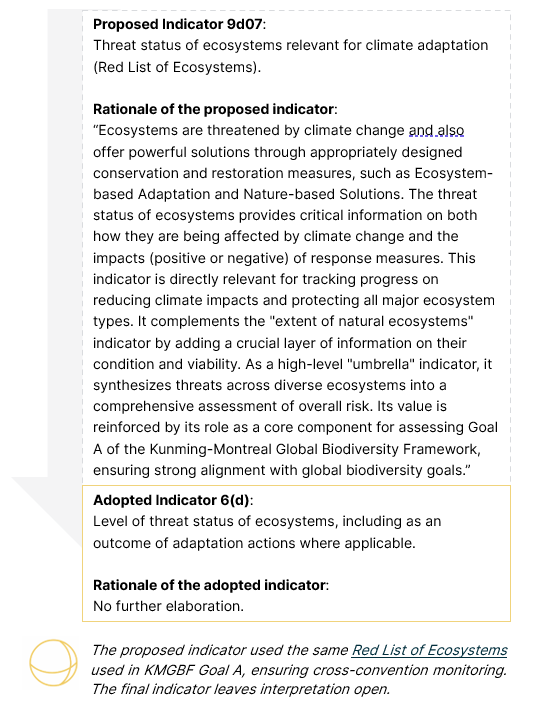
At COP30, Parties reduced these 100 to 59 Belém Adaptation Indicators, retaining six of the ten biodiversity and ecosystem indicators. The decision to reduce and simplify the adaptation targets proved controversial among several Parties. The EU described the measures as not in line with the Paris Agreement and outside the mandate of the work programme, while Sierra Leone described them as “unclear, unmeasurable, and, in many cases, unusable.” For biodiversity, explicit references to the Kunming-Montreal Global Biodiversity Framework (KMGBF) were removed (see Figure 1), weakening the indicators’ analytical rigour and opportunities for cross-convention action.
Looking ahead, the final decision on the indicators requests that the expert group provide technical guidance to the Parties and mandates the preparation of a technical paper for further operationalisation at COP31. A formal review of the indicators is scheduled for 2029, following the second Global Stocktake.
Recommendation: Although the agreed indicators are primarily designated for the Global Stocktake, Parties retain the discretion to implement more stringent methodologies in their national reporting. Subsequently, Parties should voluntarily include explicit references to biodiversity frameworks in their national monitoring initiatives, thereby enhancing coherence and establishing a more robust empirical foundation for the 2029 Global Stocktake and the indicator review.
Forest Governance: Finance Without a Roadmap
The third major biodiversity-related theme at COP30 concerned forests, which sit at the intersection of climate change, biodiversity loss, and desertification. The Brazilian Presidency strategically chose Belém, located in the Amazon Rainforest, to host the COP. It also introduced a new financial tool – the Tropical Forests Forever Facility (TFFF) – and sought consensus on a roadmap to halt deforestation.
First proposed at COP28, the TFFF is a blended-finance instrument designed to reward countries financially for conserving their tropical forests. The initiative aims to raise US$25 billion in sponsor capital to issue bonds totalling up to US$100 billion in international capital markets. Brazil used the COP30 spotlight to launch the TFFF at the high-level leaders' summit ahead of COP30. This was fairly successful: by the end of the COP, TFFF pledges totalled US$6.7 billion. Although the TFFF operates outside the formal structures of the Rio Conventions, it is intended to support their objectives and contribute to more coherent forest finance.
While many Parties – including the EU – welcomed the TFFF, it also attracted significant criticism.
While many Parties – including the EU – welcomed the TFFF, it also attracted significant criticism. 150 civil society groups and Indigenous Peoples organisations argued that the initiative “does not seek to address the true structural causes of forest destruction of agriculture, mining, hydrocarbon, and infrastructure projects.” Others expressed concern that the TFFF could further fragment an already complex climate and biodiversity finance landscape, risking reduced effectiveness.
While the TFFF was launched successfully outside the formal UNFCCC, negotiators within the COP faced more contestation when pushing a deforestation agenda. In its final Mutirão Decision – a political text intended to consolidate several contentious debates – the Brazilian Presidency proposed roadmaps to address two major challenges: phasing out fossil fuels and ending deforestation. While the roadmap on fossil fuels received significant media attention, the deforestation roadmap attracted much less coverage. In addition, while 93 countries – including the EU, Brazil, and Colombia – backed the deforestation roadmap seeking to tackle the structural causes of deforestation, no consensus was reached by the end of COP30. Ultimately, the Mutirão Decision acknowledged the goal of halting and reversing deforestation by 2030 (in line with Article 5 of the Paris Agreement) but did not include a concrete roadmap to achieve it. This was highly criticised by NSAs, with Greenpeace noting that the “divided multilateral landscape was unable to hurdle it, showcasing the disconnection with people calling for climate action.” In the closing plenary, the Brazilian Presidency announced that it would develop both roadmaps outside the COP process, with outcomes to be reported at COP31.
Recommendation: While US$6.7 billion was pledged during COP30, pledges are not the same as capital raised, and additional funding will be essential for the TFFF to achieve impact. To advance deforestation efforts, the Parties should increase funding for the TFFF; coordinate their contributions to avoid duplication with existing financial mechanisms; and establish clear monitoring of interactions among financial instruments. To better tackle the causes of deforestation, Parties should treat deforestation as a stand-alone priority rather than bundling it with more polarising negotiation tracks.
Conclusion: Key Governance Priorities for 2026
Overall, COP30 reflected growing recognition of the need to address the climate crisis and biodiversity loss as an interconnected challenge. However, multilateral constraints led to uneven outcomes across the institutional interactions, adaptation indicators, and deforestation finance and governance. Notably, the most tangible progress on synergies (i.e., the TFFF) originated outside of the formal UNFCCC process. Looking ahead, 2026 represents a critical opportunity to address COP30’s shortcomings.
COP30 was a clear wake-up call that momentum does not automatically translate into action. With major CBD and UNCCD decisions now two years old, there is a real risk that the current momentum will dissipate if 2026 does not deliver concrete progress. Failure to act would not only stall the work already initiated but would also leave countries – and ecosystems – more vulnerable to worsening climate and biodiversity impacts. In the lead-up to the June UNFCCC intersessional meetings and the COPs of the UNCCD, CBD, and UNFCCC in August, October, and November, the Parties should focus on the following governance priorities:
- Advance synergies between the Rio Conventions: Advocates of greater cooperation between the Rio Conventions should reach out to other Parties, both supporters and sceptics. Substantively, the UNFCCC COP should build on the proposals and consensus already achieved under the other Rio Conventions.
- Operationalise adaptation indicators: While the adopted indicators removed explicit references to the Biodiversity Convention, Parties should demonstrate leadership by applying rigorous, cross-convention indicators in national monitoring frameworks.
- Clarify forest finance and governance: Parties should scale up and coordinate TFFF funding, ensure it complements – rather than competes – with existing financial mechanisms, and treat the deforestation roadmap as a stand-alone priority.
Citation Recommendation: Lameire, Noa. 2026. “Act Now or Lose Momentum: Delivering on COP30’s Unfinished Climate–Biodiversity Agenda in 2026.” ENSURED Policy Brief 9 (February): 1–10. https://www.ensuredeurope.eu.


.png)


