


The European Union is in direct geoeconomic or security conflicts with major powers on all sides – China, the US, and Russia being the prime counterparts. In these conflicts, economics have acquired an unprecedented role due to the increasingly open weaponisation of economic interdependences and the power of markets. The global economic order is re-configuring, and the EU and its members look for ways to use their economic clout to shape the contours of the emerging order in their image. Do they have the tools to succeed?
Věra Jourová, former European Commission (EC) Vice-President for Values and Transparency, delivered the keynote on digital sovereignty for the EU, while Tomáš Petříček, former Czech Minister of Foreign Affairs, offered his reflections on the position of European states in the global geoeconomic turmoil. Researchers from the Horizon-Europe consortium ENSURED and from the Institute of International Relations (IIR), Prague, explored key policy areas that intersect with the EU's economic policies in global cooperation and conflicts in trade, taxation, climate, and the digital transformation.
Opening Remarks
The event opened with brief remarks by Mats Braun, Director of the Institute of International Relations (IIR), and Michal Parízek, who reflected on the current state of the world and EU's evolving role within it.
Mats Braun emphasized the economic and geoeconomic shift in power from the EU and the US towards Asia, and the implications this holds for the EU. Michal Parízek highlighted the fundamental reshaping of the global order and the challenges it presents for small states.
Keynote by Věra Jourová: Digital Sovereignty for the EU
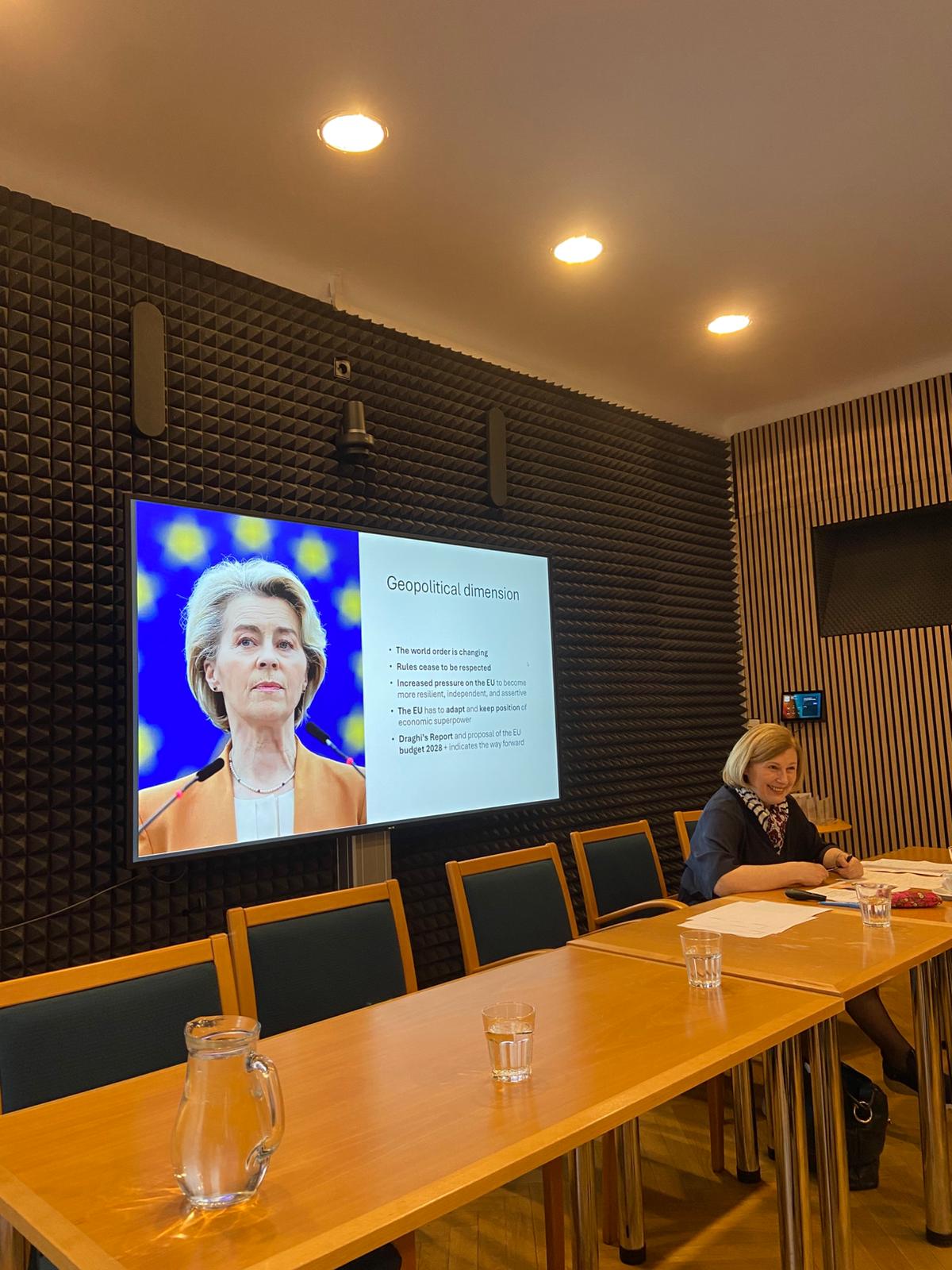
The keynote speech was delivered by Věra Jourová, former European Commission (EC) Vice-President for Values and Transparency. Jourová opened by reflecting public perceptions on “Brussels,” emphasizing the need to shift this understanding from a distant them to a more inclusive us, increasingly including academia, media, and civil society.
Turning to the central theme of digital sovereignty, Jourová distinguished it from technological and cloud sovereignty. She pointed to key achievements such as the General Data Protection Regulation (GDPR), the Digital Markets Act (DMA), the Digital Services Act (DSA), and the Artificial Intelligence (AI) Act as flagship examples of the EU’s regulatory approach, and shared insights from the challenging negotiations surrounding the so-called Business Wallet. She also raised a point about the choice between open and closed approaches to digital, technological, and cloud infrastructures, and underlined the importance of EU sovereignty over the enforcement and protection of free speech, especially in times of war.
Jourová then outlined three main geopolitical challengers the EU faces in the realm of digital sovereignty: China, Russia, and the US.
- China: She described the ‘two faces’ of China: an essential partner for cooperation on global challenges such as poverty reduction, climate change, and AI governance, but also a systemic geopolitical rival.
- Russia: She highlighted the continued threat posed by Russia, particularly in the form of cyberattacks and attacks on European critical infrastructure.
- The USA: She pointed to a deteriorating transatlantic relationship, noting concern about the lack of respect for EU digital regulations, sanctions against EU officials involved in shaping these regulations, insufficient safeguards for EU citizens’ data in the US, and the continued dependence of the EU on US digital and cloud systems.
To conclude, Jourová returned to the fundamental choice between open and closed approaches, noting a growing shift among EU policymakers towards a more protective, “data fortress” mindset. She also called for strengthening technological sovereignty and a boost for the EU tech sector and startups.
The subsequent Q&A session was opened by the French Ambassador to Czechia, who raised a question on the Czech government’s position regarding the DSA. The discussion then broadened to cover differing models of political economy in the United States and China, the strategic path the EU should pursue, and the risks posed by the influence of big money in politics.
Panel I: EU Economic Playbook and Disrupted Multilateral Cooperation
Global Digital Governance and Regulation of Cyberspace Federica Marconi, IAI Rome
Federica Marconi presented the findings of the ENSURED research on digitalisation, focusing on how digital transformation and technological development have become key drivers of geopolitical and geoeconomic power dynamics. She highlighted how these dynamics play out across diverse domains: in cyberspace, in digital currencies, and in AI. This was followed by a discussion of the EU’s position in reform negotiations across the three domains.
EU and Global Tax Competition Tomáš Boukal, IES FSV UK
Tomáš Boukal started his presentation with figures on the economically relatively limited, though still detectable impacts of recent reform steps in the international tax regime, especially the recent OECD/G20 Base Erosion and Profit Shifting agreement and its Pillar Two – the global minimum corporate tax. He pointed out how following up on the agreement, the long-term decline in average corporate tax rate slowed down or stopped. At the same time, the implementation of the agreed upon rules is slow and uneven. He highlighted several challenges for EU policy: the persistent dissatisfaction of developing countries with the OECD/G20 framework, pushing the agenda to the UN convention framework; the US strategy – apparently successful – of seeking special deals; and the merely formal, rather than substantive compliance of some states with the provisions. Jointly, these undermine the effectiveness of the reformed and transforming global tax regime.
EU and Global Climate Mitigation and Finance Jan Karlas, IPS FSV UK
Jan Karlas outlined the key dilemmas for the EU in the climate regime, both in climate change mitigation and in climate finance. In mitigation, the EU’s support for strong institutions does not match the preference of many states for larger national discretion. In climate finance, the demands (especially from developing countries) are far larger than what the EU and other developed countries are willing to consider. The discussion then turned to the EU’s concrete proposals – and the limits of its influence – in both climate mitigation and climate finance, noting that the EU remains the largest provider of climate finance.
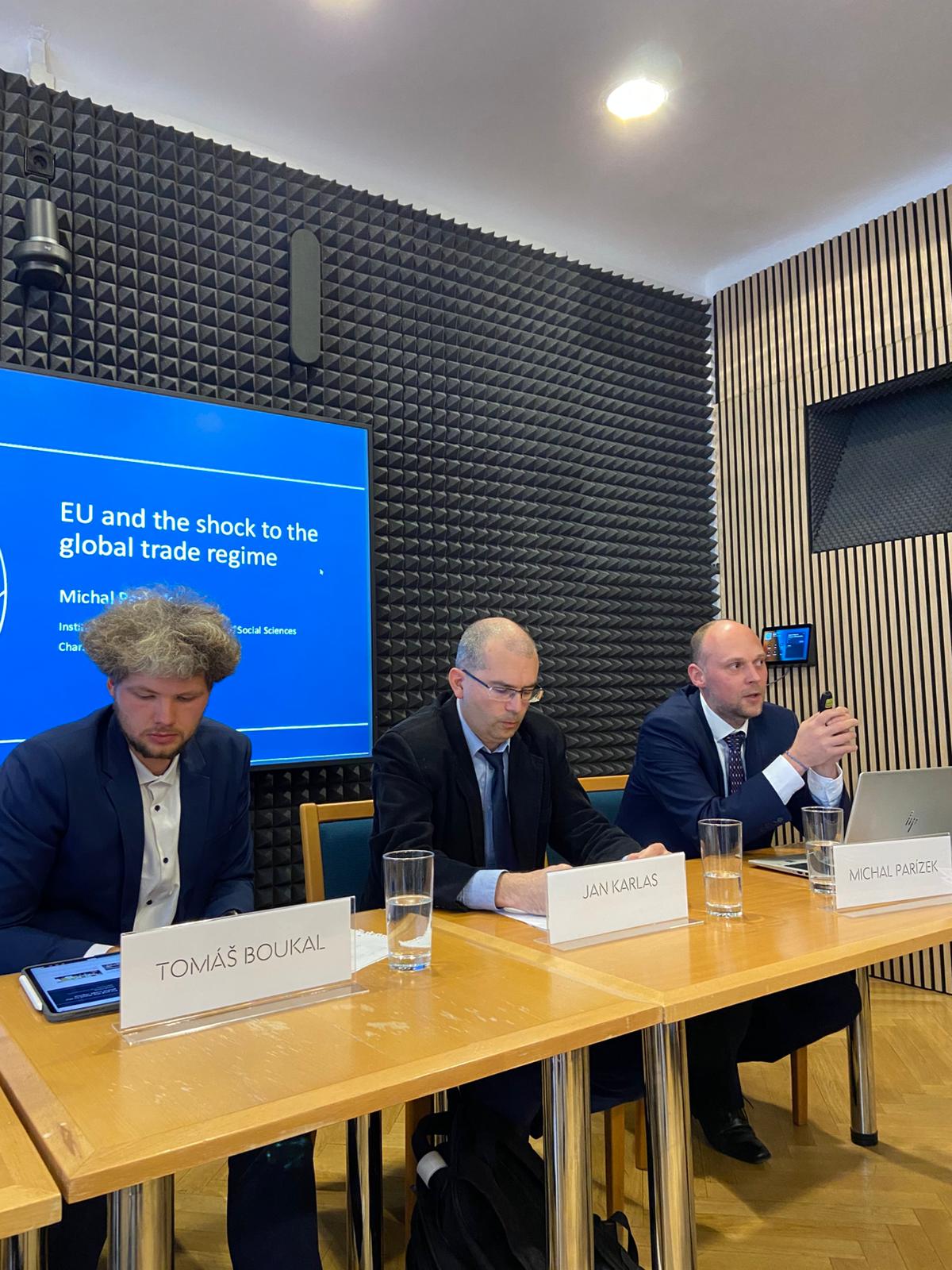
EU and the Shock to the Global Trade Regime Michal Parízek, IPS FSV UK
Michal Parízek provided an overview of the current state of the global trade regime, also referring to a recent policy brief authored by Clara Weinhardt and him. In the global trade regime, two parallel dynamics are at play: along-term reform agenda that was intended to culminate in tangible outcomes at the 14th WTO Ministerial Conference, and increasingly geopoliticised, conflictual relations among major powers. He outlined three possible options for the EU regarding WTO reform: disengagement and a focus on bilateral agreements; continued emphasis on incremental, piecemeal reform within the WTO; or a push for more fundamental institutional renewal. He noted that while the first option is likely to yield only limited long-term gains, the latter two face significant political obstacles given persistent disagreements among major powers.
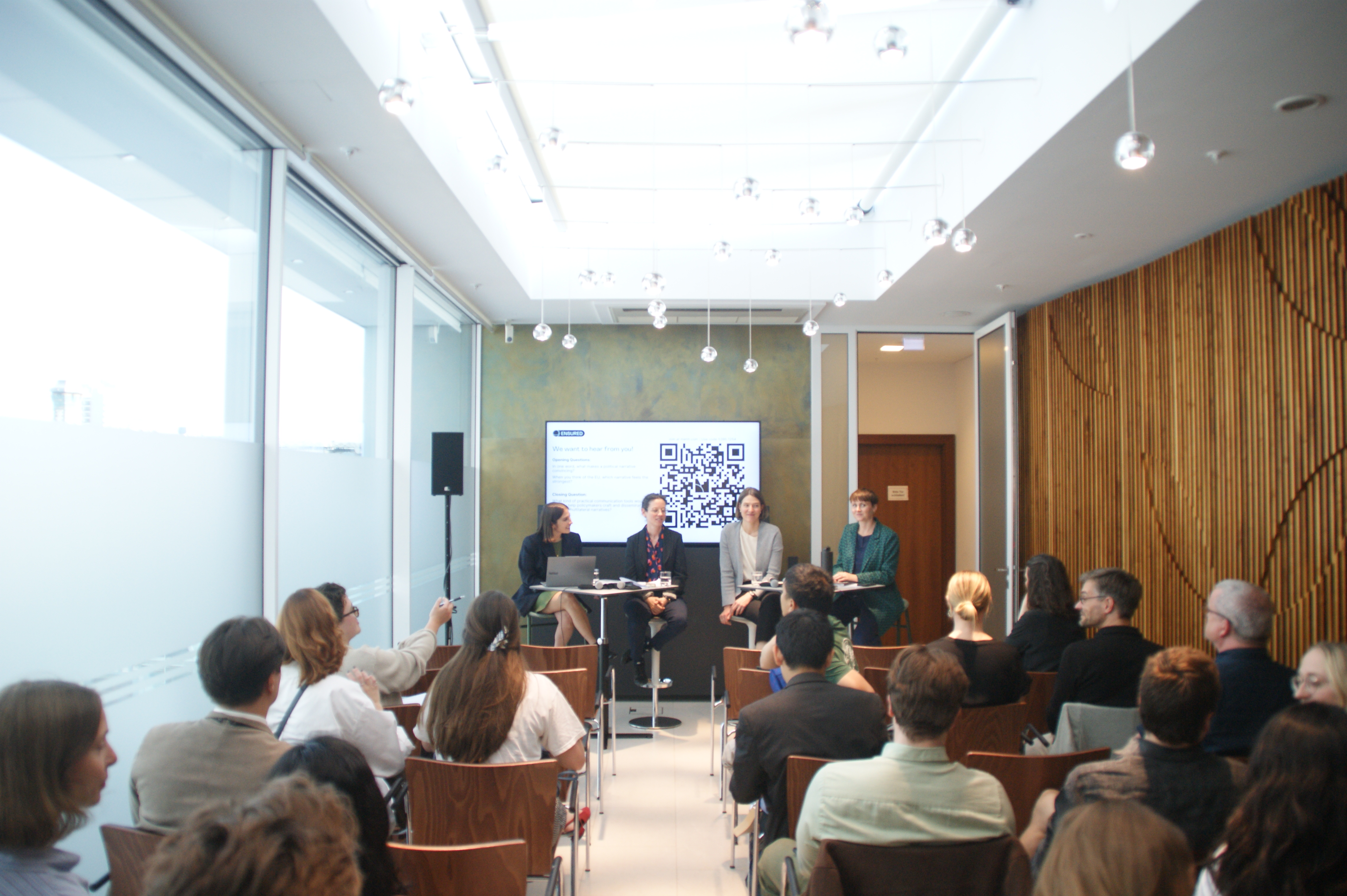
Discussion Highlights: The Q&A session of the ENSURED panel focused largely on the future of multilateralism. In particular, discussions centred on the alternative strategic choices available to the EU, how it should approach bilateral partnerships, and why it should not abandon efforts to strengthen effective multilateral structures.
Questions were raised by the French Ambassador, representatives of Czech central government bodies, as well as members of the general public, including a student newspaper.
Panel II: Czechia and Europe amid Geopolitical Turmoil
The final session was held by Tomáš Petříček, former Czech Minister of Foreign Affairs.
He began by reflecting on current geopolitical shifts, while emphasizing that the global system has not yet moved into a post-globalist phase and that levels of interdependence remain high. Against this backdrop, he argued that full decoupling is not a viable option, and that the emphasis should instead be on strategically managing overlapping, asymmetric interdependencies.
The subsequent Q&A session addressed the return of geopolitics within Europe itself, with Petříček highlighting the pivotal role of the United States in shaping these developments.
This ENSURED dissemination event was held in cooperation with the Institute of International Relations (IIR) in Prague. For more on ENSURED's work on economic policy, check out our research publications.
Photo: Christian Lue / Unsplash (Unsplash Liscense)
.jpeg)


.png)


