


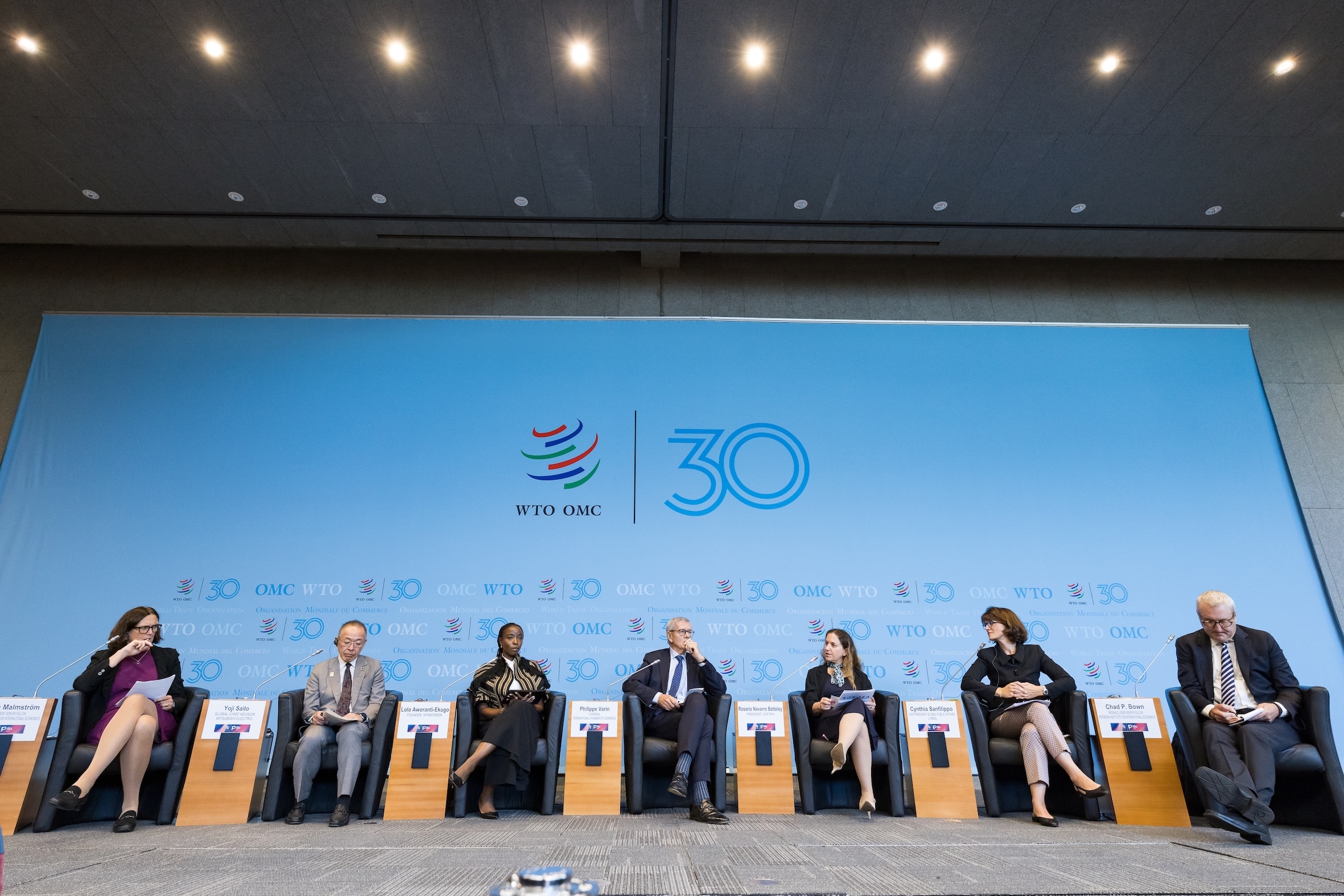

The global trade regime – which centres on the World Trade Organization (WTO) – increasingly operates in two parallel worlds. On the one hand, along-standing reform agenda seeks to modernise WTO procedures and update its rulebook to make the organisation fit for purpose. This agenda builds on nearly two decades of difficulties in the WTO’s rule-making pillar, as well as the almost decade-long blockage of its Dispute Settlement Mechanism. Recently, members have renewed efforts toward reforms, supported by a high-level reform facilitation process and an active role by the Director-General Ngozi Okonjo-Iweala.
At the same time, however, the foundations of the multilateral trading system are being undermined like never before. The United States (US) has imposed a flurry of unilateral ‘reciprocal’ tariffs, disregarding core WTO principles. These measures have been accompanied by a series of bilateral negotiations whose compatibility with the WTO framework remains uncertain. One prominent example is the Turnberry agreement struck between the European Union (EU) and the Trump administration in July 2025: it violates the Most-Favoured-Nation principle, only thinly veiled by claims that it could be made compatible with WTO rules at some point in the future. More broadly, Washington has framed such arrangements as the basis of a new global economic order built on reciprocity rather than multilateral rules.
How should the EU navigate these parallel worlds? This policy brief argues that the EU should pursue two complementary strategies. First, it should defend the WTO’s core functionality through pragmatic short-term reforms. Second, it should simultaneously build coalitions to advance modern trade rules both inside and outside the WTO framework.
The Status Quo of WTO Reform: Key Challenges
With widespread calls for the upcoming WTO 14th Ministerial Conference (MC14) in Yaoundé to become a “reform ministerial”, a recent report for the ENSURED project examines the processes and prospects of WTO reform in the first of these parallel worlds. Largely in line with the insights from the work of the WTO reform facilitator Ambassador Olberg, we find persistent difficulties across several reform processes.
First, once described as the crown jewel of the WTO, the organisation’s Dispute Settlement Mechanism has been essentially paralysed for more than six years. The US’s blockage of appointments to the Mechanism’s Appellate Body since 2017 allows any member dissatisfied with a first-stage panel ruling to “appeal into the void”, preventing an authoritative resolution of the dispute.
The intensive reform process on dispute settlement, which was intended to culminate in an arrangement addressing US concerns by the end of 2024, has failed to deliver. Even prior to the second Trump administration, US concerns extended far beyond procedural adjustments and increasingly reflected geopolitical and security considerations, including geoeconomic competition with China’s state-capitalist model. With the return of a Trump administration, the prospects for reforming the Dispute Settlement Mechanism have all but disappeared.
Second, progress in rule-making reform looks equally bleak. While members reached a modest Agreement on Fisheries Subsidies at MC12 in 2022, plurilateral agreements negotiated by large groups of WTO members since 2017 have encountered resistance from a small number of members who oppose incorporating these agreements into the WTO rulebook as so-called Annex IV agreements. India and South Africa have been the most vocal critics of these plurilateral processes, even though the majority of WTO members – developed, developing, and least-developed countries (LDCs) alike – have been keen to participate.
Many observers argue that it is necessary to move away from a consensus system that effectively grants each member veto power. Instead, consensus decision-making should require greater responsibility from all members and avoid allowing a single member to block collective progress.
Although there is widespread agreement on the need for WTO reform, major powers hold radically different views about the organisation’s purpose.
Frustration with the current institutional design has become particularly evident in the case of the Investment Facilitation for Development (IFD) plurilateral agreement. More than 120 WTO members requested that the agreement be incorporated into the WTO rulebook in February 2024, yet the request is still pending. The IFD agreement follows a Most-Favoured-Nation structure: it is only binding for participating parties, while its benefits extend to all WTO members. However, for the agreement to enter into force, approval by all WTO members, including those not bound by the agreement, is required.
Third, although there is widespread agreement on the need for WTO reform, major powers hold radically different views about the organisation’s purpose. China primarily seeks to restore the WTO to its pre-2017 functioning. India emphasises the need for the WTO to finally deliver on the development objectives of the Doha Round. The EU wants the WTO to revive rule-making and dispute settlement, while also tackling hot topics like China’s heavy use of opaque subsidies. The US, meanwhile, has grown increasingly frustrated by the WTO's failure to contain China’s distorting economic policies and is sceptical that the organisation can deliver gains that could not be obtained through other channels. In a consensus-based institution, such divergent interests significantly limit the prospects for meaningful reform.
The EU and WTO Reform: Past Efforts, New Challenges
The EU has traditionally been a strong supporter of WTO reform efforts, a fact most visible around dispute settlement. After the WTO’s Appellate Body became dysfunctional, the EU championed a temporary alternative mechanism in 2020: the Multi-Party Interim Appeal Arbitration Arrangement (MPIA). Initially supported by 16 members, including China, participation has since grown to 31 (counting the EU and all its member states as one member), representing close to 60 percent of global trade.
To reform the WTO’s negotiation function, the EU has also supported more flexible formats that allow groups of willing members to advance new agreements and decisions. At the same time, it has advocated for negotiations on emerging issues like the trade-environment nexus, greater focus on trade inclusiveness in the WTO agenda, and updated rules to address distortive forms of state intervention.
More recently, however, the EU has increasingly bowed to US pressure to abandon the rules-based multilateral trading system. The US-EU Turnberry agreement, concluded in July 2025, violates the WTO’s Most-Favoured-Nation principle. Although the European Parliament suspended the deal’s ratification this February due to legal uncertainties, this reflected concerns about legal clarity rather than a U-turn on its substance. Antonio Costa, the President of the European Council, defended the deal as a part of a broader strategy to secure continued US support for Ukraine.
The EU’s willingness to sideline its commitment to WTO rules has raised questions about its credibility as a champion of trade multilateralism. It is no wonder, then, that navigating between the ‘two worlds’ of the global trading system has become more difficult for Europe.
EU Approaches to WTO Reform
The EU now faces three main options in approaching WTO reform:
Option 1: Disengage from reform and focus efforts elsewhere. Given that past reform efforts have delivered few results, one option would be to deprioritise WTO reform and concentrate on bilateral and regional free-trade agreements – i.e., the US approach. However, unlike the way Washington has used these negotiations to undermine WTO rules and principles, the EU could pursue this strategy to promote open, rules-based trade through such agreements. This would imply a partial shift away from the WTO and risk further fragmentation of the global trading system. At the same time, it could generate some tangible results – as illustrated by the recent free-trade agreements with India, Indonesia, and the Mercosur countries.
Option 2: Pursue piecemeal reforms to keep the WTO functional. In light of the US’s aggressive attempts to undermine the existing system, a second option would be to strategically focus on practical reforms that preserve the organisation’s basic functionality in the short term. This would involve prioritising more achievable initiatives, including greater support for plurilateral agreements among willing members. On dispute settlement, the EU could seek increased support for the MPIA given the deadlock in negotiations over the Dispute Settlement Mechanism itself. This strategy could then be re-evaluated in a future ‘post-Trump’ era. At the same time, the EU could continue to build alliances with like-minded partners outside of the WTO framework. While this approach would do more to prevent further fragmentation of the trading system as compared to the first option, it would not by itself resolve the underlying tensions in the global trade regime.
Option 3: Work to fundamentally renew WTO rules. A third option would involve investing in more ambitious efforts to fundamentally reform the WTO in the medium to long term. This would require addressing controversial issues such as subsidies and the role of state-owned enterprises, restoring a fully functional Dispute Settlement Mechanism, and revisiting flexibilities for developing countries that have become major economic players. In this scenario, the current ‘Trump shock’ to the trading system could potentially generate the political momentum needed to advance more comprehensive reforms, as rising protectionism increases incentives for compromise. While this option has the potential for the greatest long-term gains for the EU, it is also risky: the EU could end up helping undermine, perhaps irreparably, the very system it seeks to reform. The success of such an approach hinges on other major powers’ willingness to conform to the EU’s (and US’s) fundamental concerns.
Policy Recommendations
In light of these tough choices, the EU should pursue a dual strategy for WTO reform that reflects the two parallel worlds of the global trade regime. In the short term, it should prioritise pragmatic, piecemeal reforms that preserve the organisation’s core functionality. At the same time, the EU should intensify efforts to build coalitions aimed at developing modern trade rules both inside and outside the WTO. This approach avoids the risks of disengagement while recognising the limited prospects for comprehensive reform in the current geopolitical climate.
The EU should pursue a dual strategy for WTO reform that reflects the two parallel worlds of the global trade regime.
- Preserve the WTO’s core functionality in the short term.
Disengaging from the WTO would carry significant costs for the EU as an export power. The WTO acquis – including its rules and accumulated case law – remains a valuable asset. The EU should therefore prioritise efforts that defend the existing system of open, rules-based trade.
A key priority should be strengthening the MPIA as a stop-gap tool for dispute settlement and expanding its membership. To make participation more attractive to a broader range of WTO members, the EU should facilitate access for developing countries, including by adapting proposals from the ongoing, formal reform discussions regarding developing countries’ participation in dispute settlement.
The EU should also continue to push for plurilateral agreements within the WTO. While these initiatives have faced resistance in the past, the current geopolitical context – including the ‘Trump shock’ and the US’s increasingly coercive approach to trade policy – may soften entrenched opposition among some members. At the same time, the EU should not completely disengage from more ambitious reform discussions. However, it should remain realistic about their limited prospects under current geopolitical conditions and prioritise more achievable initiatives.
- Build coalitions for modern trade rules.
Relying on piecemeal reforms alone carries risks. A growing disconnect between WTO reform processes and the dynamics of geoeconomic competition outside the organisation could eventually undermine the organisation’s relevance.
To sustain a rules-based trading system in the medium term, the EU should therefore build coalitions with like-minded partners both outside and within the WTO. Outside the organisation, bilateral and regional trade agreements can help defend and expand the ‘WTO template’, particularly in areas where multilateral negotiations remain blocked, such as digital trade, subsidies, and the trade-environment nexus. The EU has already taken steps in this direction, including through intensified trade cooperation with partners in the Indo-Pacific.
- Safeguard EU credibility in the multilateral trading system.
The upcoming MC14 in Yaoundé in March 2026 offers an opportunity to strengthen broader coalitions in support of a rules-based trading system. Yet there is also a risk that too assertive a position could undermine the EU’s broader credibility in the trading system.
The recent EU proposal to reinterpret the Most-Favoured-Nation principle illustrates these concerns. While possibly intended to inject urgency into reform debates, it risks being perceived as aligning with US positions and undermining a central pillar of the WTO. As many observers have argued, the Most-Favoured-Nation principle remains essential for ensuring efficiency and protecting against power asymmetries in the global trading system. At a time when competing powers seek to position themselves as defenders of multilateral trade, the EU’s credibility and reliability are strategic assets. Indirectly responding to the EU’s proposal, China’s own reform position – which re-affirms the Most-Favoured-Nation principle – demonstrates how easily others can claim leadership by championing the existing regime. Addressing the need to rewrite WTO rules will require carefully balancing the members’ interests – something a direct challenge to the Most-Favoured-Nation principle is unlikely to achieve.
Similarly, the EU should consider greater flexibility in the reform of special and differential treatment. Its recent suggestion to introduce “objective and transparent criteria” for developing country status risks provoking resistance among a broad range of WTO members. More pragmatic approaches to reforming development flexibilities, including sector-specific criteria, are more likely to attract support while avoiding unnecessary damage to the EU’s credibility among its trade partners.
Citation Recommendation: Weinhardt,Clara and Michal Parízek. 2026. “The WTO Between Two Worlds: Strategic Choicesfor EU Action.” ENSURED Policy Brief 11 (March): 1–9. https://www.ensuredeurope.eu.


.png)


