



Far-right parties are often seen as opposed to international environmental policies, yet your current research shows this is not always the case. In what different ways do far-right governments approach international environmental agreements and institutions?
There is a common perception that far-right governments are uniformly opposed to international environmental agreements and institutions, whether it be the Paris Climate Agreement or the Convention on Biological Diversity. Yet when we look beyond the United States, we see significant variation in how far-right governments position themselves in international environmental negotiations.
First, to state the obvious, some far-right governments are indeed strongly opposed to international environmental agreements. The United States is a case in point: President Trump withdrew the United States from the Paris Agreement in both his first and second terms in office. His administration also halted US funding for the United Nations Framework Convention on Climate Change Secretariat (UNFCCC), which oversees the annual climate negotiations, prompting US philanthropist Michael Bloomberg to step in to fill the funding gap. What is more, Trump is a staunch climate denier: at the United Nations General Assembly in 2025, he described climate change as the “greatest con job ever perpetrated on the world”. Instead, he has strongly advocated for policies to expand “big, beautiful coal” production. Trump’s administration justified its withdrawal from the UNFCCC by arguing it was “saving taxpayer money and refocusing resources on America First priorities”.
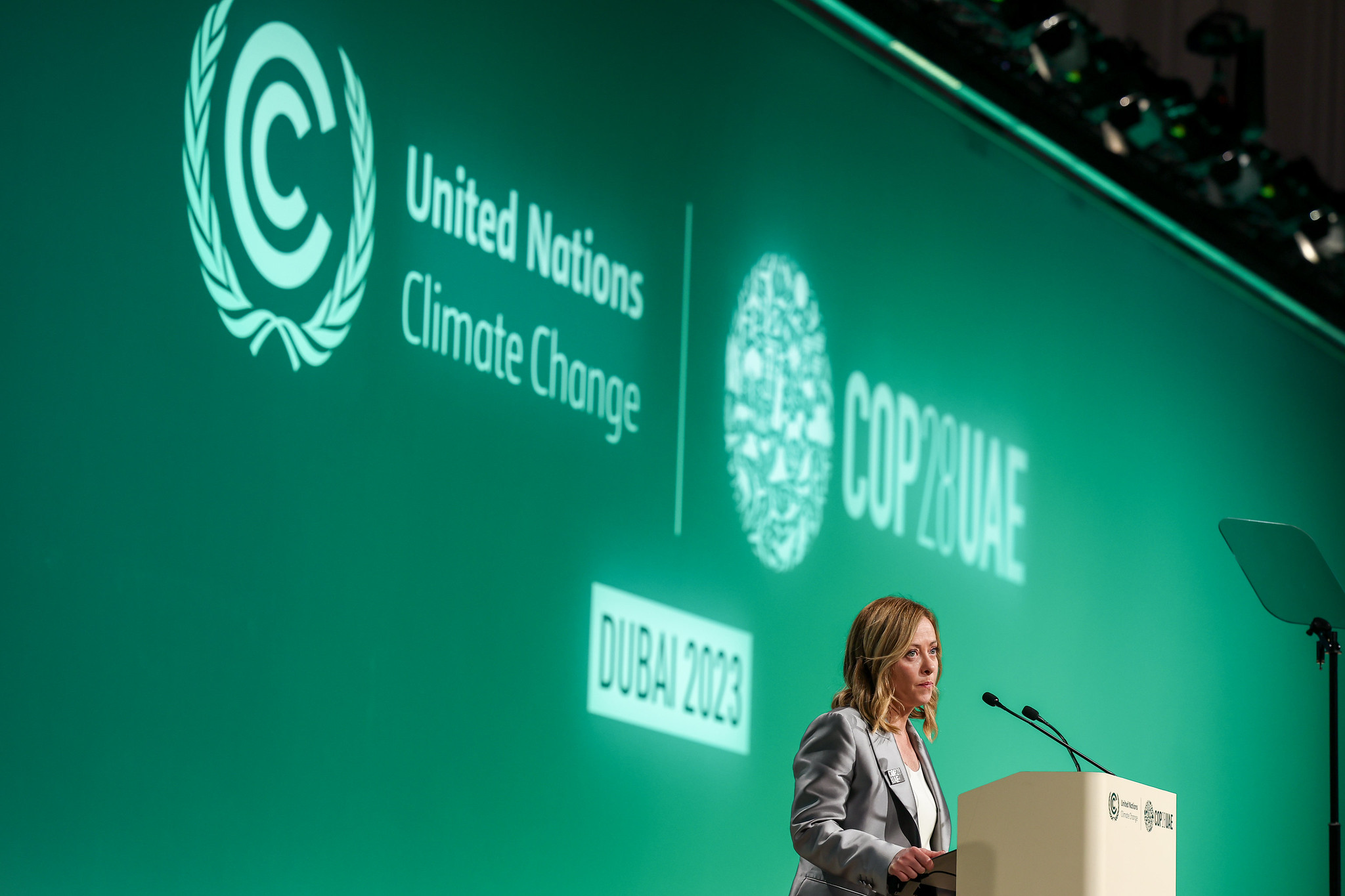
However, not all far-right parties, once in power, reject international environmental organisations and agreements. Some have actively promoted multilateral action on climate change. For example, Giorgia Meloni, Italy’s prime minister and leader of Fratelli d’Italia, has frequently attended UNFCCC conferences and expressed support for meeting the goals of the Paris Agreement. In her first speech at the UNFCCC in 2022, she stated: “We owe this to our future generations, since our commitment to protect the environment as part of our identity is the most vivid example of the alliance between those who are here, those who were here, and those who will come after us. Italy will provide its fair share.”
Meloni’s speech to the United Nations General Assembly in 2025 contrasted strongly with Trump’s address that same year. Meloni argued that her environmental policy was “not about denying climate change” but “affirming reason”, by which she meant “technology neutrality, and a gradual approach to reform instead of ideological extremism”. Notably, Meloni also pledged €100 million to the new “loss and damage” fund at COP28 in Dubai in 2023 – the largest initial pledge made by any country. This funding is intended to support Global South countries facing severe climate impacts, although the Italian government has yet to deliver on its promise.
"We should not automatically assume that far-right governments are always opposed to international climate agreements and institutions."
Meloni is not alone. Other far-right political parties in government have also expressed commitments to addressing climate change, including Fidesz in Hungary, Law and Justice in Poland, and the Bharatiya Janata Party (BJP) under Prime Minister Modi in India. Modi, for instance, launched the International Solar Alliance in 2015 to promote solar energy uptake in developing countries. When he was still Chief Minister of Rajasthan, he authored a book calling for stronger climate action. Modi has also received the United Nations Environmental Programme’s “Champions of the Earth” award for his pledge to eliminate single-use plastics in India. That said, Modi’s track record is somewhat mixed: he has expressed climate scepticism at times and supported the expansion of coal-based power. Modi has also imposed strict limitations on the operations of Greenpeace and other environmental advocacy organisations, including restrictions on their access to foreign funding.
This goes to show that we should not automatically assume that far-right governments are always opposed to international climate agreements and institutions. Rather, more research is needed to understand when and why governments – whatever their political stripes – engage in international environmental agreements, and to what extent they actually deliver on the pledges they make internationally.
How might multilateral environmental institutions themselves adapt – or struggle – to maintain cooperation as far-right parties enter government in more countries?
For decades, international environmental organisations have dealt with states seeking to obstruct or delay progress in international negotiations. The rise of far-right governments, many of which are sceptical of multilateral institutions, certainly introduces additional challenges. However, it is also common practice for governments to pursue their national interests in international negotiations. International Relations scholars expect some level of disagreement between states given the vast differences in their geopolitical power, economic structures, and the ideologies of their leaders. In fact, the entire point of international organisations is to navigate these differences and find space for compromise – and, where possible, agreement. It is also worth recalling that climate cooperation has often succeeded despite political tensions: governments have signed literally hundreds of international environmental agreements over the past century.
Moreover, obstructionist tactics are widespread and deployed by both democracies and authoritarian regimes, with examples ranging from New Zealand to Saudi Arabia and Russia. Governments have delayed negotiations through procedural manoeuvres, blocked consensus, and introduced ambiguous language to undermine international agreements. A growing body of scholarship examines these dynamics under the rubric of climate obstructionism and ‘discourses of delay’. Meanwhile, at the UNFCCC annual conference of the parties, civil society groups award a daily “fossil fuel of the day” prize to publicly name and shame governments that engage in such behaviour.
However, many international organisations are facing serious challenges today. As the UN celebrates its 80th anniversary, it does so amid massive funding shortfalls. In 2026, the UN plans to cut more than 15 percent of its budget and 18 percent of staff positions as compared with 2025. Governments have reduced both mandatory and voluntary contributions across the board. These cuts will have significant consequences for what the UN – and its environmental institutions – can deliver.
How can proponents of environmental protection and climate action respond to this challenging international context?
It is important to recognise the long and diverse history of environmentalism, rather than assuming that environmental protection is inherently a progressive cause owned by the political left. Throughout history, environmentalism has been championed by activists and intellectuals from across the political spectrum. In the nineteenth century, many of the strongest advocates for environmental protections prioritised traditional values, were opposed to modernisation and industrialisation, and framed environmental protection as a form of conservatism rooted in continuity and restraint.
Environmentalism has also often been linked to nationalism. Environmental campaigns are typically framed as national struggles, associated with distinct cultural identities and attachments to land. In twentieth-century Europe, for example, many environmentalists also tapped into national pride to argue for the preservation of natural landscapes and forests. In Germany, for instance, some of the first environmental organisations advocated for protecting the natural environment (Naturschutz) as a means of safeguarding the homeland (Heimatschutz). A similar logic underpinned the establishment of the United Kingdom’s Royal Society for the Protection of Birds as well as the National Trust. At times, environmentalism and nationalism have reinforced one another.
"At times, environmentalism and nationalism have reinforced one another."
Conservative politicians have also played roles in advancing climate action: both Margaret Thatcher and George H. W. Bush supported the creation of the UNFCCC. Although the Bush Senior Administration later undermined climate action by seeding doubt in the scientific consensus. In contrast, Thatcher was among the first leaders to adopt a science-based position on climate change in the late 1980s and established a dedicated climate research institute, the Met Office Hadley Centre.
In short, there is no inherent link between progressive politics and environmental protection. Conservatives can – and sometimes do – advance climate action. Scholars and commentators should therefore remain intellectually curious and explore how conservative groups can and have in the past become climate champions, rather than assuming they will always act as climate obstructionists.
Nina Hall is Associate Professor of International Relations at Johns Hopkins SAIS Europe. Her current research explores how countries led by far-right leaders engage in global environmental politics. She has ongoing research on transnational advocacy, international organizations, climate litigation and New Zealand foreign policy.
You can also find content from ENSURED's Expert Blog on the Global Policy website.
Photo: UNFCCC / Flickr (CC BY-SA 2.0)


.png)


